How to Propagate Pothos From Stem Cuttings
Pothos grows new plants from stem cuttings that include a node, rooted in water or in moist mix. This guide shows where to cut, what will not work, and how to use rooted cuttings to fill out a thin pot.
At a glance
What you need
- Clean sharp snips or scissors
- Rubbing alcohol for the blades
- Glass jar
- Room-temperature water
- Small pot with drainage holes
- Airy rooting mix with perlite
Rooting speed varies by plant, season and conditions.
A pothos that has grown long and a little bare at the top is the ideal candidate for propagation. The vines you trim off become new plants, and those new plants can go into fresh pots or straight back into the original one to fill it out.
Learning how to propagate pothos comes down to one idea: every cutting needs a node. This guide covers golden pothos and its varieties (Epipremnum aureum), the methods that suit the plant, the ones that do not, and how to get a fuller pot at the end.
Which methods suit pothos, and which do not
Pothos is propagated from stem cuttings. You have two forms to choose from, and both work in water or directly in moist mix:
- Tip cuttings: the end of a vine with a few nodes and leaves.
- Single-node cuttings: short stem sections, each with one node and one leaf, which give you more plants from one vine.
Two approaches do not suit it:
- A leaf with only its stalk. A pothos leaf pulled or cut off at the petiole has no node, so it cannot grow a new vine. It may stay green in water for a while, but it will not become a plant.
- Division in the usual sense. Pothos does not form a crown that you split. A full pot is normally several separate cuttings planted together. Those can simply be teased apart into smaller pots, but that is separating individual plants, not dividing one.
Find the nodes before you cut
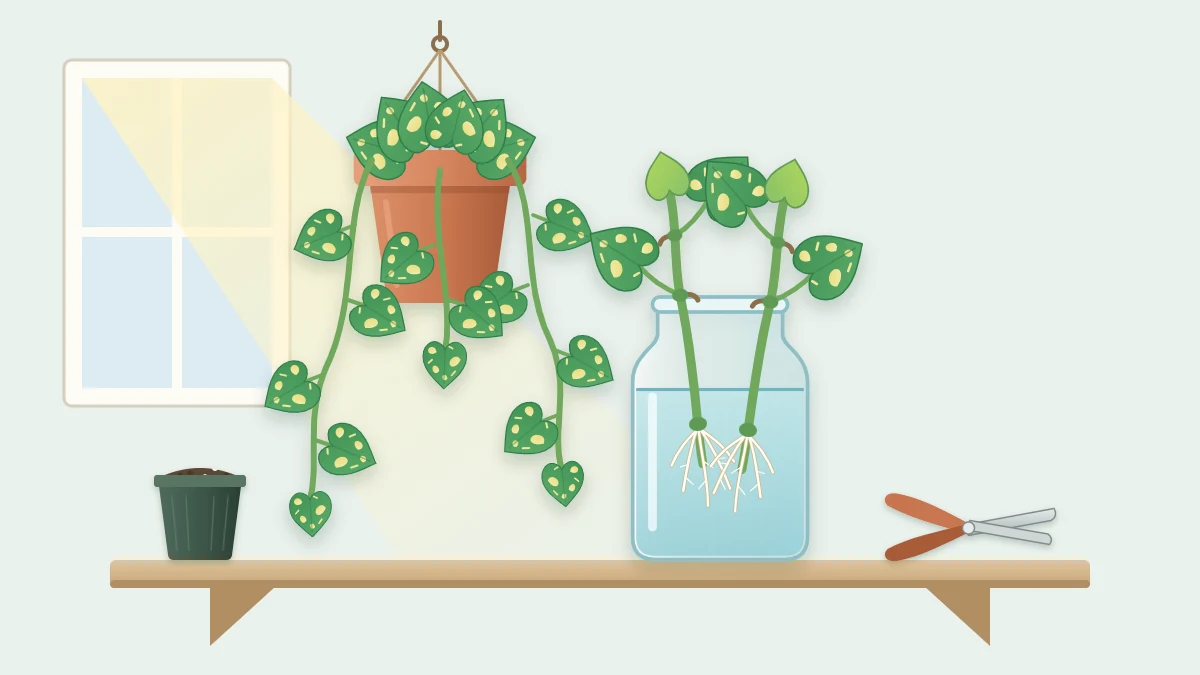
Run a finger along a vine and you will feel a slight joint wherever a leaf stalk attaches. On the stem opposite each leaf there is usually a small brown nub. That nub is an aerial root waiting to grow, and it marks the spot where new roots will form once it is in water or mix. If you want more background, see the guide to what a plant node is.

Choose healthy vines with firm stems and leaves of good color. Long bare stretches with no leaves are less useful: those nodes can still root, but a cutting with a leaf has more to work with.
Take the cuttings
- Wipe the blades of your snips or scissors. Rubbing alcohol on the blades is a method extension services commonly describe.
- Cut the vine a little below a node, about 1/4 to 1/2 in (roughly 0.5 to 1 cm) under it.
- For tip cuttings, keep a piece with a few nodes. For single-node cuttings, cut the vine into sections so each has one node and one leaf, with a short stub of stem on either side.
- Remove the leaf at any node that will be submerged or buried. A leaf left under water or under the mix tends to rot.
- Take several cuttings. Pothos is among the more willing houseplants to root, but some cuttings still fail.
Good to know
The ASPCA lists golden pothos as toxic to dogs and cats; see the ASPCA entry for golden pothos. Keep cuttings, trimmings and jars out of reach of pets. The sap can also irritate skin, so wash your hands after cutting or wear gloves.
Root the cuttings in water
- Fill a clean glass jar with room-temperature water.
- Stand the cuttings in it so at least one node is under water and all the leaves are above it.
- Set the jar in bright indirect light, away from direct sun and cold glass.
- Refresh the water every few days, or whenever it looks cloudy.
Watch the nodes. The brown nub swells and turns pale, then a white root pushes out and eventually begins to branch. Branching roots are the sign that a cutting is getting ready for a pot. The general method, including jar choice and water, is covered in how to propagate plants in water.
Water-grown roots need a gentle move into mix. When your cuttings reach that point, follow the steps for transitioning water roots to soil.
Or root them directly in mix
Rooting in mix skips the transfer later. Use a small pot with drainage holes and an airy rooting mix, such as potting mix lightened with perlite.
- Moisten the mix so it is evenly damp, like a wrung-out sponge, and never soggy.
- Make a hole with a pencil and set each cutting in so the node is just below the surface.
- Firm the mix lightly around the stem so the cutting stands on its own.
- Keep the pot in bright indirect light and keep the mix evenly moist.
You cannot see roots in mix, so look for other signs: a new leaf starting to unfurl, or slight resistance when you give the cutting a very light tug. Rooting hormone is optional here. Pothos commonly roots without it. If you choose to use one, read and follow the product label.
How long it takes
There is no honest single answer. Pothos tends to root readily compared with many houseplants, but speed still depends on warmth, light, the season and the health of the parent plant. Cuttings taken during active growth in a warm, bright room generally move faster than those taken in a cool, dim one.
Highly variegated varieties, with large areas of white or yellow, have less green tissue to feed the cutting and can be slower. Give them the brightest indirect light you have and judge them by what the nodes are doing, not by the calendar.
Make the parent plant fuller
Trimming a vine does not make a pothos bushy on its own. A cut vine usually sends out one or two new shoots from the nodes nearest the cut, so it carries on as a vine with a fork in it.
A fuller pot comes from more stems in the pot. Once your cuttings have rooted, plant several of them back into the mix of the parent pot, spaced around the edge and in any bare patch in the middle. Each one adds a new vine at soil level, which is where a leggy plant looks thin.
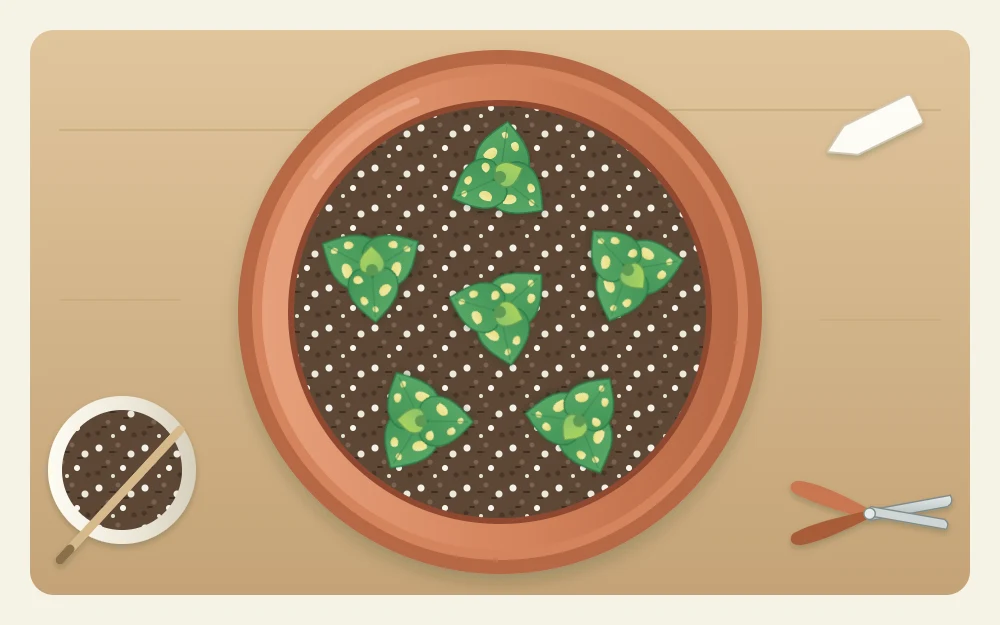
The same approach works for starting a new pot. Plant a group of rooted cuttings together, and keep the mix evenly moist while the roots settle in.
Frequently asked questions
Can you propagate pothos from just a leaf?
No. A pothos leaf with only its stalk has no node, so there is no point for a new vine to grow from. It can stay green in water for some time, which is misleading. Always include a piece of stem with a node, the joint where the leaf stalk meets the vine.
Is it better to root pothos in water or in soil?
Both suit pothos. Water lets you watch the roots form, which is helpful for a first attempt, but the cutting then has to adjust when it moves to mix. Rooting directly in moist, airy mix avoids that move, though you have to judge progress by new leaves and a light tug.
How many pothos cuttings should go in one pot?
There is no set number. Each cutting usually becomes one vine, so a single cutting gives a thin pot. Planting several rooted cuttings together, spaced around the pot, gives a fuller look from the start. Use a pot only as large as the group of roots needs, so the mix does not stay wet.