What Is a Node? How to Find Nodes on Houseplant Stems
A node is the point on a stem where a leaf attaches, and many cuttings cannot grow without one. Learn how to spot nodes, tell a leaf stalk from a stem, and where to place the cut.
“Cut just below a node” appears in almost every set of propagation instructions, usually with no explanation attached. If you have been left asking what is a node, and how you are supposed to find one on your own plant, the answer is simpler than the vocabulary makes it sound.
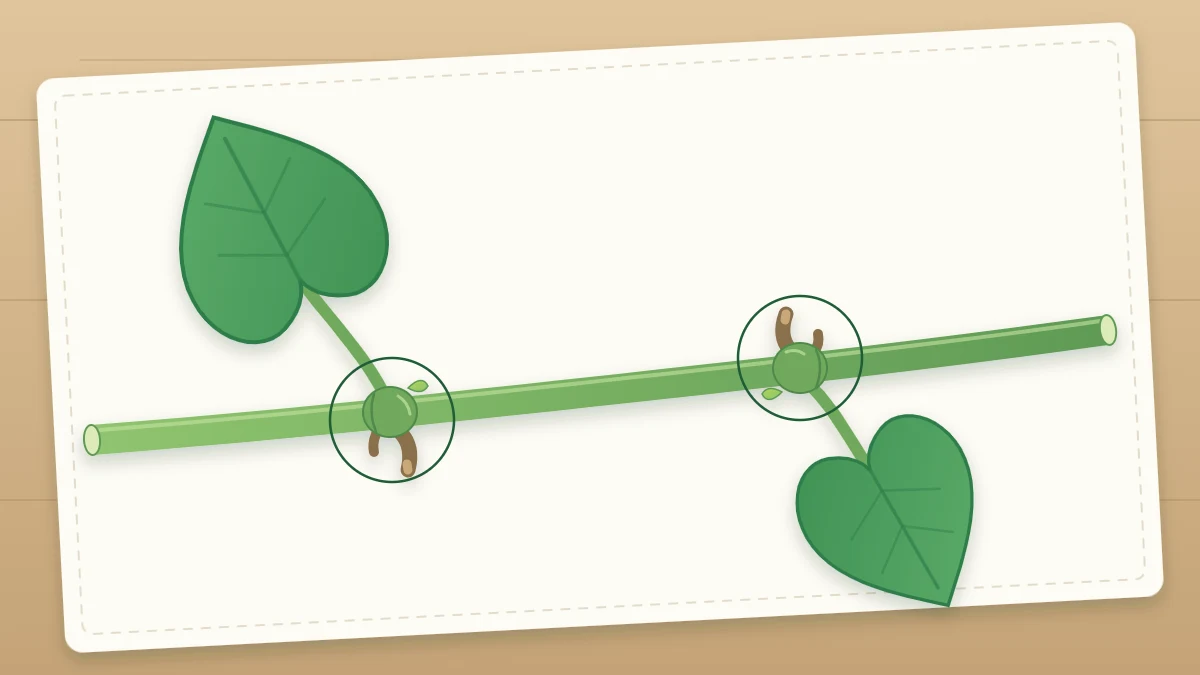
A node is the point on a stem where a leaf attaches. On many houseplants it is the most important part of a cutting, because it is the place new roots and new shoots come from.
What a node is, in plain terms
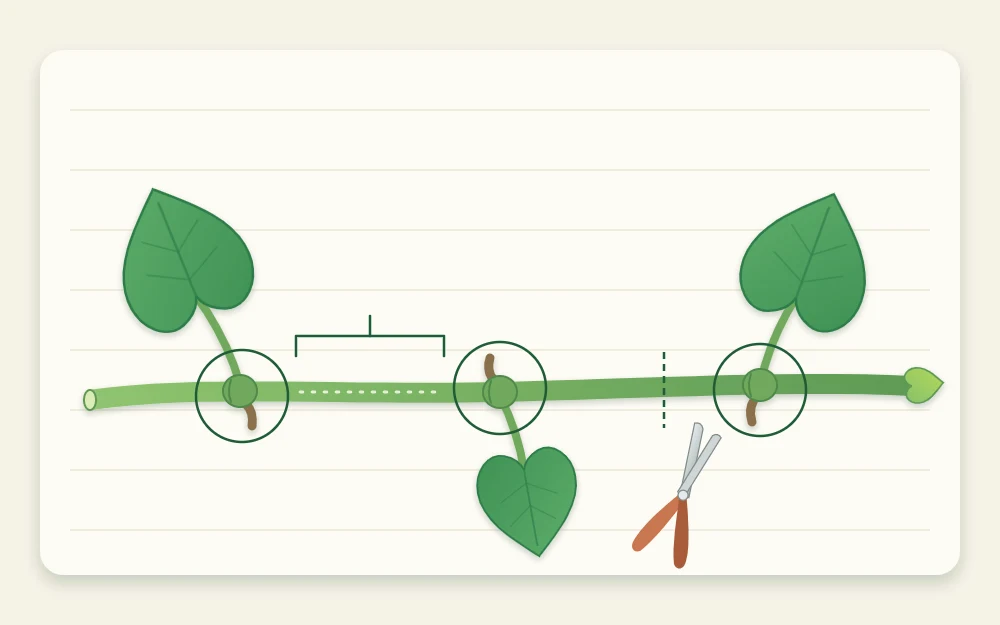
Look at any vining houseplant and you will see that leaves do not sprout at random. They join the stem at regular points, and each of those points is a node. Two things sit there that matter for propagation:
- A dormant bud. It is tucked into the leaf axil, the angle between the leaf stalk and the stem. It is often tiny and easy to miss, but it can grow into a whole new shoot.
- Aerial root nubs. On many vining plants, such as pothos, heartleaf philodendron and monstera, the node also carries one or more small brown bumps. These are the beginnings of aerial roots.
The stretch of bare stem between two nodes has its own name: the internode. It carries water and sugars along the stem, but it has no bud.
Why nodes matter for cuttings
On most vining and cane-type houseplants, including pothos, heartleaf philodendron, monstera and dracaena, new roots and new shoots can only come from a node. The dormant bud becomes the new stem, and the roots form at the node or from the nubs already sitting there.
An internode has neither. A length of bare stem with no node may stay green for a while, but it has nothing to grow from. That is the reason a cutting of these plants needs at least one node, and why the instructions keep repeating the word.
How many nodes a cutting carries, and whether it comes from the tip of a vine or the middle, changes how it behaves. The differences are covered in the guide to the types of stem cuttings.
How to find nodes on a stem
Work with the plant in good light and take your time. Nodes are easier to spot on some plants than others, so use more than one clue.
- Follow a leaf back to the stem. Trace the leaf stalk, called the petiole, down to the point where it joins the stem. That junction is a node.
- Look for a slight swelling. The stem is often a little thicker or knobbier at a node than along the internode.
- Look for a ring or a scar. Where an old leaf has dropped, it often leaves a line around the stem or a small scar. The node is still there even though the leaf has gone.
- Look for a small brown nub or an aerial root. On vining aroids it usually sits just below or opposite the leaf.
- Use your fingertips. Run them lightly along the stem. The nodes are the bumps you feel; the internodes are smooth.
On a pothos vine the nodes are spaced out and easy to read, which makes it a good plant to practice on. The pothos propagation guide uses exactly these landmarks. On a monstera the stem is thicker and the nodes may sit close together, each with a sturdy aerial root. On a dracaena cane the leaves are long gone from the lower stem, and the nodes show as rings of leaf scars.
Petiole versus stem: the mistake to avoid
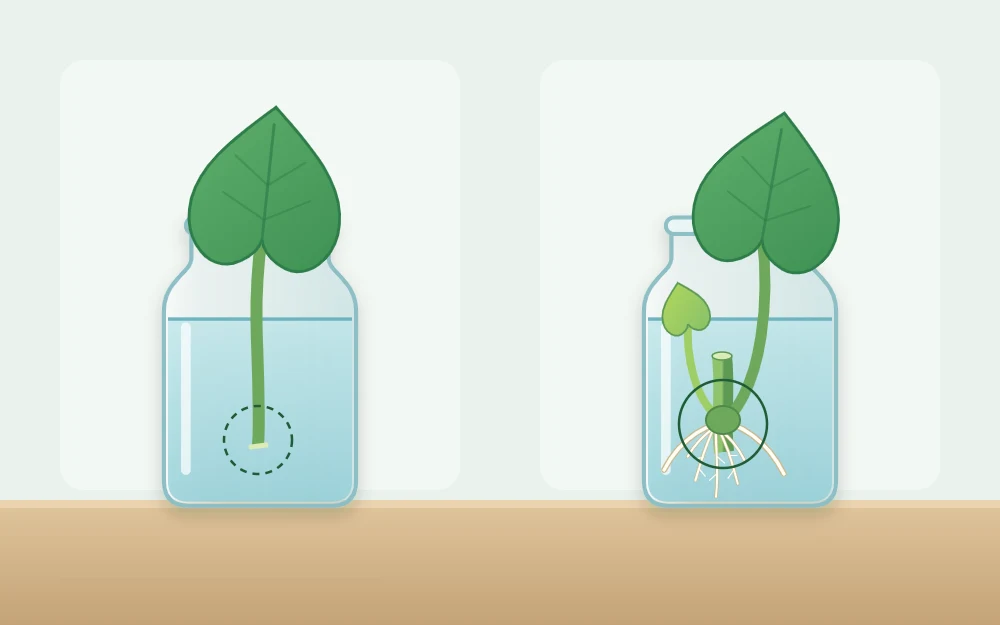
The most common beginner error is confusing the leaf stalk with the stem. They can look alike, especially on a pothos or a monstera, where the petiole is long, green and round. The difference is what each one is attached to. A petiole carries a single leaf blade at its end. A stem carries several leaves, one at each node.
If you snap off a pothos or monstera leaf with only its stalk and no piece of stem, you have left the node behind. That leaf may stay green in a jar of water for a long time, and it can even grow roots. It will not produce a new vine, because it has no bud to grow one from.
Tip
Before you cut, check that the piece you are about to remove includes a short length of the main stem, not just a leaf and its stalk.
Where to cut
For the base of a cutting, cut a little below a node. That leaves the node at the bottom of the cutting, where it will sit in water or rooting mix, with only a short stub of stem beneath it. A long tail of bare internode below the node adds nothing, and it is more tissue that can go soft.
The node itself should stay whole. Avoid slicing through it or through the nub beside it. The full sequence, from choosing a vine to placing the cutting, is in how to take stem cuttings.
Plants that grow from a leaf alone
Everything above applies to plants that grow from stems. Some houseplants work differently. African violets, some peperomias, snake plants and many succulents can produce a new plant from a leaf, or from part of one, with no piece of stem involved. In these plants the ability to form both roots and new shoots is carried in the leaf itself.
That is not a loophole in the node rule. It is a different group of plants with a different way of growing, and it is the reason the method always has to match the plant. A snake plant leaf section and a pothos leaf look like similar starting points, yet only the first can become a new plant.
A quick check before you cut
- You have found the point where a leaf stalk meets the stem.
- You can see or feel a swelling, a ring, a scar or a small brown nub there.
- The piece you plan to remove includes that point, with a piece of stem on each side of it.
- Your cut will land a little below the node, not through it.
If all four are true, the cutting has what it needs to start. Not every cutting with a node will root, so take more than one when the parent plant can spare them.
Frequently asked questions
Can a pothos leaf grow roots without a node?
A pothos leaf with only its stalk can stay green in water for a long time and may even grow roots. It will not produce a new vine, because the bud that makes new stems sits at the node, which was left behind on the parent plant.
How do I find a node on a stem that has lost its leaves?
Look for what the leaf left behind: a ring or line around the stem, a small scar, a slight swelling or a brown nub. On bare vines and canes these marks show where each leaf used to attach, and the node is still there.
Do all houseplants need a node to propagate?
No. Vining and cane-type plants such as pothos, monstera and dracaena need a node on a stem cutting. African violets, some peperomias, snake plants and many succulents can grow from a leaf, while clumping plants are divided instead. The method has to match the plant.