Propagation Tools and Supplies: What You Actually Need
An honest kit list for propagating houseplants, sorted into essential, useful and optional, with the reasons small containers work better and the items you can skip.

You can start propagating houseplants with very little. Most of the propagation tools that matter are already in a kitchen drawer or a cupboard, and the few things worth buying are small and inexpensive.
The list below is split three ways: what is essential, what is useful once you have a few cuttings on the go, and what is optional. It ends with the things you can leave on the shelf.
Essential: a sharp, clean cutting tool
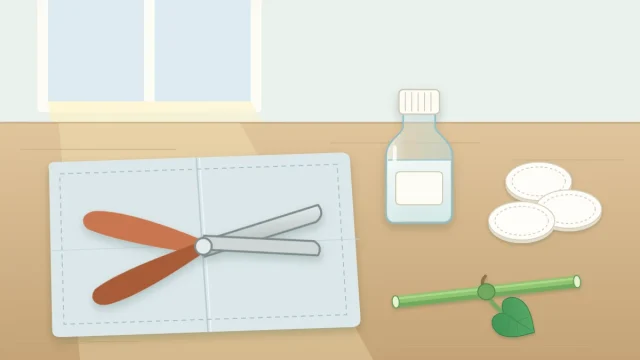
The one tool that affects results is the blade. A sharp one slices through a stem and leaves a neat surface. A dull one crushes the tissue, and crushed tissue is where rot tends to start. Match the tool to the plant:
- Bypass snips or sharp scissors for soft stems, such as those of pothos and heartleaf philodendron. Bypass blades pass each other like scissors and cut cleanly.
- A clean knife or a razor blade for fleshy stems and for leaf sections, such as jade plant stems or snake plant leaves. Squeezing these between two blades bruises them; a single sharp edge on a firm surface does not.
Ordinary household scissors are fine for soft vines as long as they are sharp. If they chew through paper, they will chew through a stem.
Essential: something to clean the blade with
A blade carries sap and soil from one plant to the next, and with them any problems the first plant had. You need a cloth or paper towel to wipe the blade and something to disinfect it. Rubbing alcohol on the blades is a method extension services commonly describe. The routine, and how to make the cut itself, is in how to make clean cuts and sanitize your tools.
Essential: containers
What you root in depends on where the cutting is going.
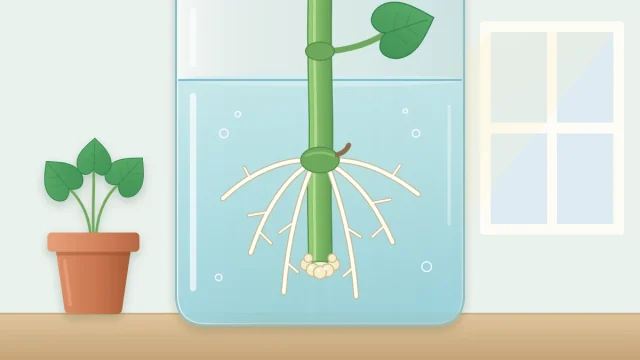
- For water: glass jars, drinking glasses or small bottles. Clear glass lets you see roots and notice when the water turns cloudy. A narrow neck holds a cutting upright with its leaves out of the water.
- For rooting mix: small pots or cell trays with drainage holes. The holes are not negotiable. A container that cannot drain holds water around the base of the cutting.
Reused containers are fine once they have been washed. Clean yogurt cups with holes poked in the base do the same job as nursery pots.

Why small containers beat large ones
A cutting has no roots yet, so it cannot take up the water held in a big volume of mix. In a large pot that mix stays wet for a long time, with little air in it, around a cut end that is already vulnerable. A small pot or cell holds only a little mix, so it drains and dries at a pace that is easier to manage.
Small containers also take up less room under a humidity cover, let you fit several cuttings on one tray, and make it obvious when roots reach the drainage holes. Move up a size only once there are roots to fill it.
Essential: a rooting medium
The last essential is whatever the cutting sits in. For water rooting that is plain room-temperature water. For everything else it is a rooting mix: something that holds moisture evenly but stays airy, often built from ingredients such as perlite, coir or sphagnum moss. Succulents such as jade plant and echeveria need a grittier, faster-draining mix than leafy vines do.
Use fresh mix for cuttings, not old mix tipped out of another pot. The choices, and which plants each one suits, are compared in rooting medium for cuttings.
Useful: small things that make the work easier
None of these is required for a first attempt. Each one solves a specific problem.
| Item | What it is for |
|---|---|
| Clear plastic bag or lidded clear box | A humidity cover for leafy cuttings in mix, which lose water through their leaves before they have roots. Not for succulents, which need dry air around them. |
| Labels and a pencil | The plant name and the date. Pencil does not fade or run when it gets wet. |
| Spray bottle | Dampening the surface of the mix gently without washing a cutting out of place. |
| Chopstick or dibber | Making a hole in the mix first, so the cut end is not scraped or bent on the way in. |
| Tray | Catching drips and letting you move a group of small pots in one go. |
Tip
Label every container on the day you fill it. Unrooted cuttings of different plants can look alike, and the date is the only record of how long each one has really been sitting there.
Optional: heat, light and rooting hormone
Three things are sold to propagators and are worth understanding before you decide whether you need them.
- A seedling heat mat. It warms the mix from below, which can be a help in a cool room. In a home that is comfortably warm, cuttings of common vines such as pothos root without one.
- A grow light. Worth considering if you have no spot with bright indirect light, or in the darker months. A bright windowsill out of direct sun does the same job.
- Rooting hormone. It is optional. It may help with plants that are slow or hard to root, and many common houseplants root without it. If you do use it, read and follow the product label. The guide to rooting hormone for houseplants explains when it is worth considering.
What you do not need
A good deal of propagation equipment is decoration. You can skip all of the following without affecting your cuttings:
- Dedicated propagation stations. Test tubes in a wooden stand look nice, but a clean jar holds a cutting just as well.
- Large or deep pots. They work against an unrooted cutting, for the reasons above.
- Fertilizer. A cutting with no roots cannot use it. It can wait until the new plant is growing.
- A big kit bought in one go. Begin with a blade, a container and a medium. Add an item only when you meet the problem it solves.
Good tools do not make every cutting root. Some fail whatever you use, which is one more reason to keep the kit simple and take several cuttings instead of one.
Frequently asked questions
Can I use regular kitchen scissors to take cuttings?
Yes, for soft stems such as pothos and heartleaf philodendron, as long as the scissors are sharp and clean. Dull blades crush the stem instead of slicing it. For fleshy stems and leaf sections, a clean knife or razor blade on a firm surface gives a neater cut.
Do I need rooting hormone to propagate houseplants?
No, it is optional. Many common houseplants root without it. It may help with plants that are slow or hard to root. If you decide to use a rooting hormone product, read and follow the label on the package.
What size pot should I use for a cutting?
A small one with drainage holes. An unrooted cutting cannot take up the water held in a large volume of mix, so a big pot stays wet around the cut end. Small pots or cell trays drain and dry at a more manageable pace.