How Roots Develop on Cuttings: From Callus to Root System
What is happening at the cut end while you wait: the wound seals, callus may form, root initials appear and the first white roots branch into a root system.
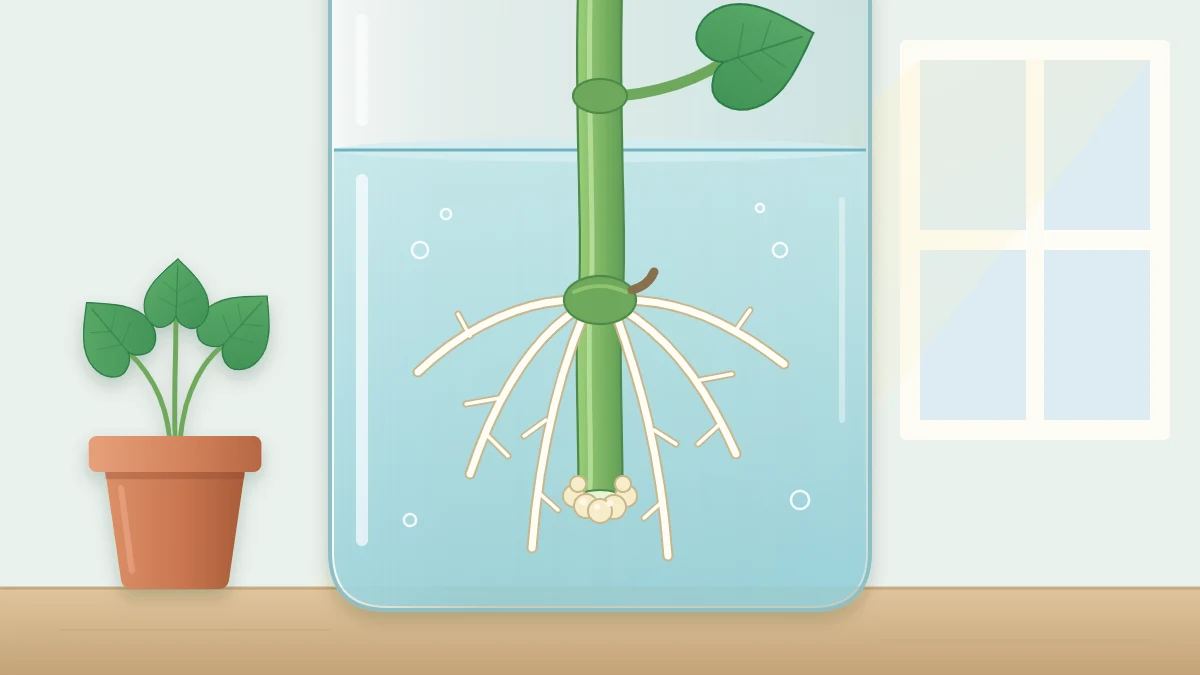
A cutting in a jar can look as though it is doing nothing at all. Inside the stem, quite a lot is going on, and knowing how roots develop on cuttings makes the wait easier to read. You stop asking whether it is working and start noticing which stage you are looking at.
This is the plain-language version of the biology: what happens at the cut end, what powers it, and why nobody can honestly tell you how long it will take.
Roots from a place that had none
Roots normally grow from other roots. A cutting has none, so it has to build them from stem or leaf tissue instead. Roots that form this way, on a stem or a leaf, are called adventitious roots.
Not every plant part can do this, which is the reason propagation methods differ from plant to plant. Vines such as pothos and heartleaf philodendron form these roots readily at their nodes. Other plants form them from a leaf, and some are multiplied by division because their pieces already have roots.
The sequence, stage by stage
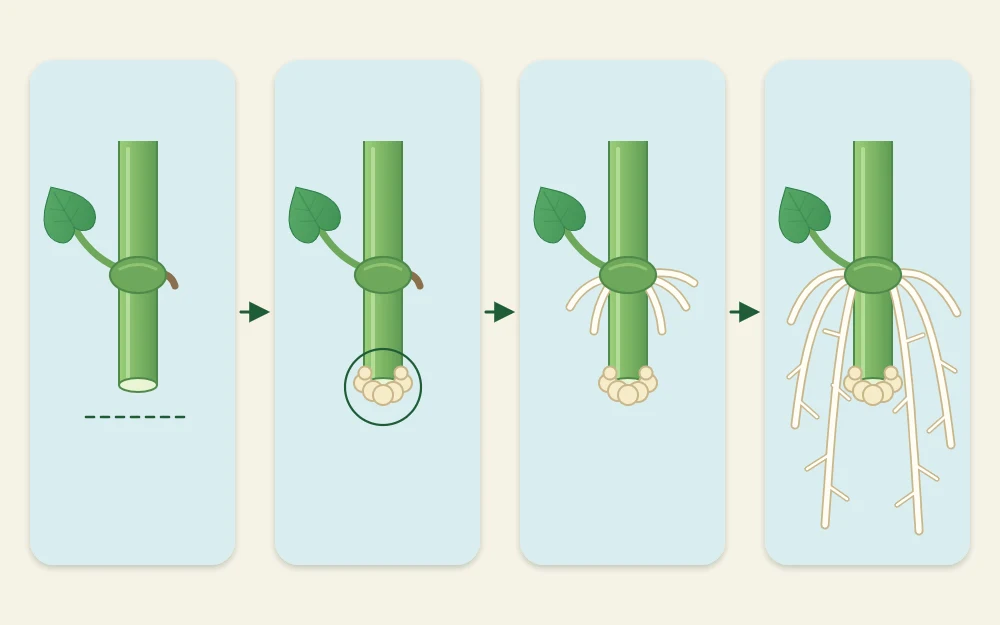
The wound seals
The first job is damage control. Cells at the cut surface dry and close over, which slows water loss and makes the open end harder for rot to enter. On succulents this sealing is the stage you wait for on purpose, by leaving the cut end to dry before it goes into mix.
A callus may form
On many plants a pale, lumpy mass of cells then builds up at the cut. This is callus. It is a sign that the cutting is alive and active, but it is not itself roots, and it does not tell you that roots are about to follow. Some plants root with very little of it. Others sit as a callus for a long time before anything else appears.
Root initials form
Next, small groups of cells inside the stem change course and organize into the beginnings of roots, called root initials. They usually form at or near a node. On vining aroids such as pothos and monstera, roots often grow from the aerial root nubs already present at the node, which gives those plants a head start. If nodes are unfamiliar, see what a node is and how to find one.
The first roots push out
The initials break through the surface as short, white, unbranched roots. In water you can watch this happen. In mix you cannot, and the kindest thing to do is leave the cutting undisturbed.
Roots lengthen and branch
The first roots grow longer, send out side branches and develop fine root hairs, which do much of the work of taking up water. This is the point at which the cutting can begin to support new leaves. A single long root is a start; a branching set is a root system.
What powers the process
A cutting has been cut off from its supply lines, so everything it builds comes from a short list of resources.
- Stored energy. Sugars and starches already in the stem and leaves pay for the early stages. A cutting from a healthy, well-fed parent plant starts with more in reserve.
- Light on the leaves. Leaves keep making sugars in light, which tops up the reserve. That is why leafy cuttings are kept in bright indirect light, not in a dark cupboard and not in hot direct sun that dries them out.
- The plant’s own auxin. Auxin is a natural plant hormone made mainly in shoot tips and young leaves. It moves down the stem and collects near the cut, where it helps trigger root formation.
- Warmth. The cells involved work faster in a warm room than in a cold one.
- Moisture and oxygen at the cut. New roots need both at once. A cut end that dries out stalls, and one that sits in stale water or soggy, airless mix is more likely to rot than root.
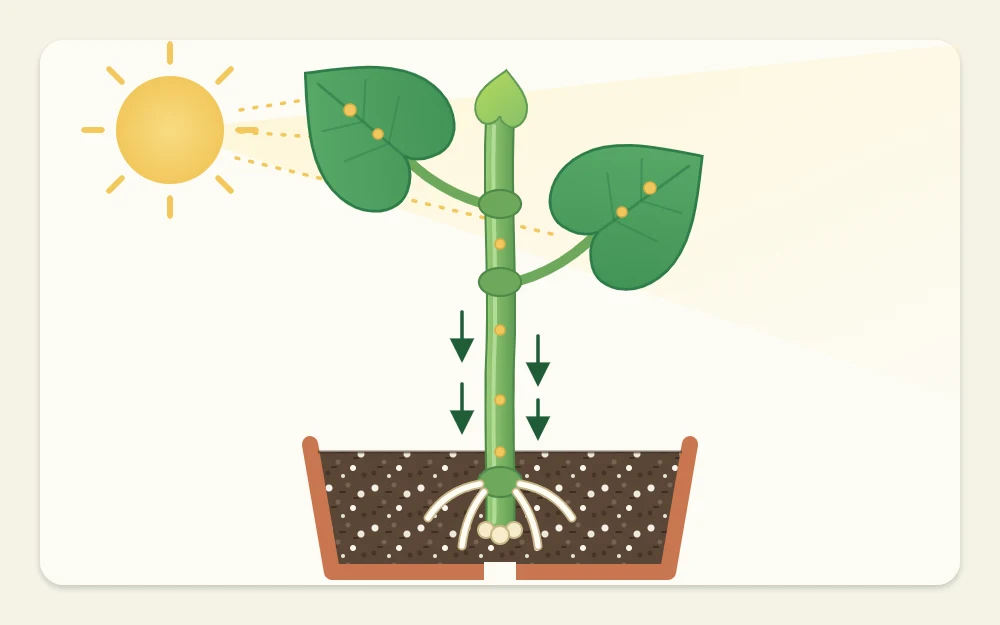
Why orientation matters
Auxin travels in one direction: from the tip end of a stem toward the root end. A piece of stem keeps that direction after it is cut, even when it has no leaves and both ends look the same. The same applies to leaf sections, such as pieces of a snake plant leaf. Roots form at the end that was nearer the plant’s base.
Tip
When you cut a stem or a leaf into several sections, keep them all lined up the same way, or mark the lower end of each one, so none goes into the mix upside down.
What you may notice above the surface
Often, nothing for a while. The leaves may droop slightly or look dull while the cutting has no way to replace the water it loses. This quiet stretch is normal and does not by itself mean failure.
Later, the leaves tend to firm up again as roots begin taking in water. Then a new leaf appears. New growth at the top is the most reliable sign from above that roots are working below. A cutting in mix that resists a very light tug is another hint, though it is better not to test often.
Why timing cannot be promised
Every stage above runs at a pace set by several things at once: the species, the season, the temperature, the light and the condition of the parent plant. Change any one and the pace changes. Some vines show roots within a couple of weeks in warm, bright conditions, while other plants can take months and still be perfectly healthy.
A slow cutting is not necessarily a failing one. If the stem is firm and the leaves hold their color, waiting is usually the right move. If you want to check the likely reasons for a long delay, see why cuttings are not rooting.
Healthy roots and failing ones
Healthy new roots are white to cream and firm. Roots that are failing turn brown, soft and slimy, and the stem above them often darkens too. Color alone can mislead, since roots grown in mix may be stained by it, so go by firmness as well.
Roots grown in water still have to adjust when the cutting is potted up. That step is covered in moving water roots to soil.
Frequently asked questions
Is callus the same as roots?
No. Callus is a pale, lumpy mass of cells that forms over the cut on many plants. It shows the cutting is alive and active, but it is not roots. Some plants root with very little callus, and others stay at the callus stage for a long time.
Why does a stem section need to be the right way up?
The plant's own auxin moves in one direction, from the tip end of a stem toward the root end, and a cut section keeps that direction. Roots form at the end that was nearer the base, so a section placed upside down is working against itself.
What do healthy new roots look like?
Healthy new roots are white to cream and firm, and over time they lengthen and branch. Roots that are brown, soft and slimy are failing. Because rooting mix can stain roots, check firmness as well as color before deciding that something is wrong.