Cuttings Not Rooting: Possible Reasons and What to Check
A cutting that stays green but shows no roots is often just slow. Here are the checks worth making, from the node and the water line to warmth, light and season, and how to tell when to keep waiting.

A cutting that sits in its jar looking perfectly healthy and doing nothing at all is one of the more frustrating parts of propagation. If you are dealing with cuttings not rooting, the first thing to know is that there is no fixed rooting time. Speed depends on the species, the season, the temperature, the light and the health of the parent plant.
A cutting that is still firm and green is still in the game. Some plants, and some times of year, are simply slow. Before you give up, work through the checks below. Each one is a possibility rather than a verdict, and more than one can apply at once.
First, confirm the cutting is still healthy
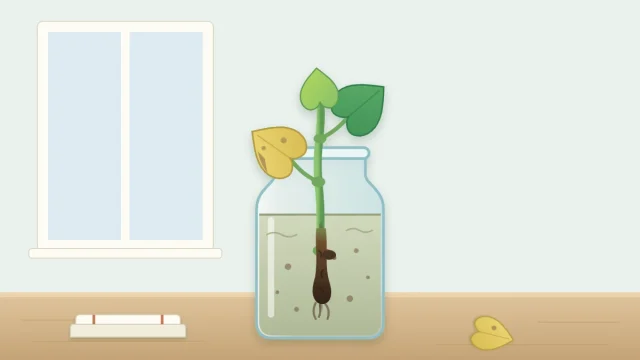
Look at the cutting and handle it gently. A stem that feels firm, leaves that hold their color and a cut end that is pale or dry rather than dark and mushy all suggest the cutting is alive and still working.
A lot happens before anything is visible. The cut end seals, and the tissue near the node reorganizes before the first root tip pushes out. The guide to how roots develop on cuttings describes those stages, which makes a quiet jar easier to read. The earliest signs to look for are small pale bumps at the node, well before anything resembles a root.
Check for a node, and check where it is sitting
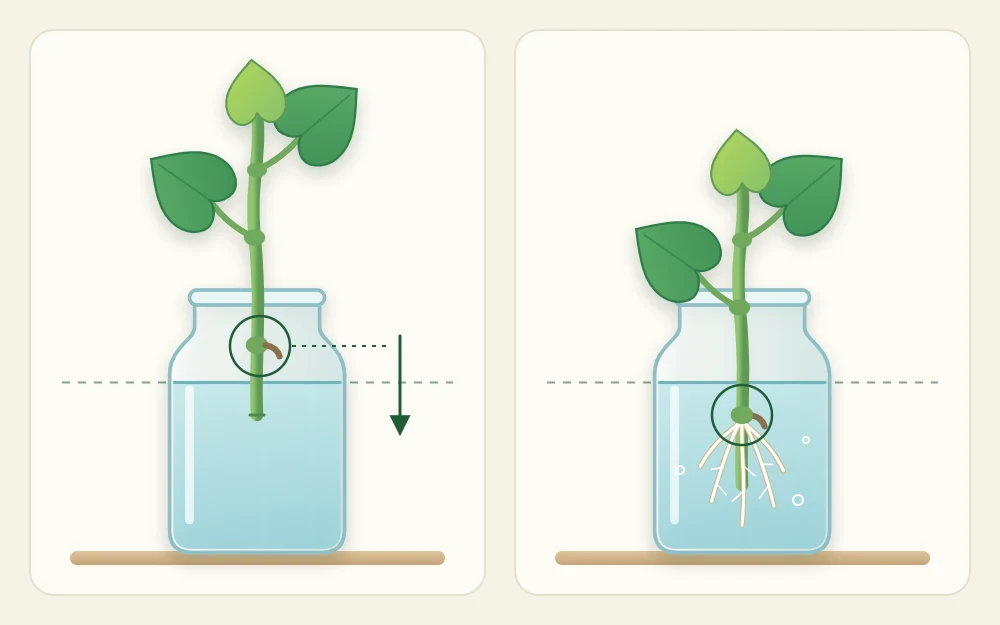
With vining plants such as pothos and heartleaf philodendron, this is the single most common reason for a cutting that never roots. New roots on these plants grow from the node, not from a bare length of stem and not from a leaf stalk. If the piece has no node, or the node is sitting in the air above the water line or above the surface of the mix, the cutting can stay green for a long while without producing anything.
Lift the cutting and look. If you are not sure what you are looking for, the article on what a plant node is and how to find it covers it. Then lower the cutting, or add water or mix, so the node is covered while the leaves stay clear.
Check the warmth and the light
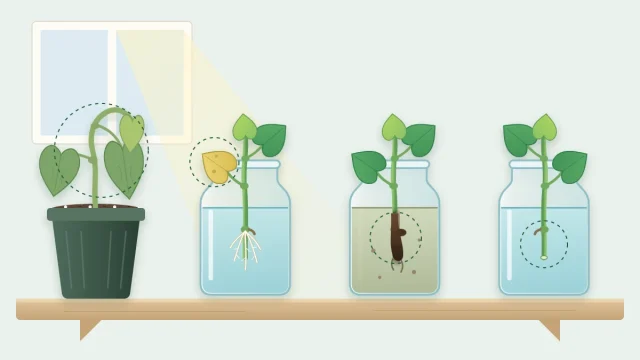
A cool room is a common brake on rooting. A jar on a cold windowsill can sit in water that is noticeably colder than the room, especially overnight and in winter. Touch the glass. If it feels chilly, move the cutting somewhere warmer and out of drafts. There is more on this in the guide to humidity and warmth for cuttings.
Light matters just as much. A cutting has no roots yet, so the leaves have to supply the energy for making them. In a dim corner the leaves can stay green and still not produce enough to build roots. Bright indirect light is the target: a bright spot where direct sun does not fall on the leaves or heat the jar.
Check the season and the piece you took
Many houseplants slow down in the darker, cooler part of the year, and cuttings taken then often wait. If the parent plant is not putting out new leaves, a slow cutting is not surprising.
The part of the stem you cut also plays a role. Old, woody stem tends to be slower to root than younger growth, while a very soft new tip can be too tender and may wilt or collapse before it gets going.
You may also find the stem end sealed over with a dry or slightly corky layer of callus. On an otherwise healthy cutting, that is often just a slow cutting. A callus is a normal response to being cut.
Check the water, the mix and how often it is moved
- Stale water. Water that has gone cloudy or has sat unchanged for a long time holds less oxygen. Change it every few days or when it looks cloudy, and rinse the jar.
- Mix that is too wet. A rooting mix kept soggy leaves little air around the stem. Aim for evenly moist, like a wrung-out sponge.
- Mix that is too dry. If the mix dries out completely around the node, any root tips that have started can dry up with it.
- Repeated disturbance. Pulling a cutting out of the mix to check on it, or moving it from water to mix and back again, can break off new root tips and set it back each time.
Tip
For a cutting in mix, test with a very light tug instead of lifting it out. Slight resistance suggests roots are holding.
Change one thing at a time
If you change everything at once, you will not learn what was holding the cutting back. Pick the most likely cause from the checks above, adjust it, and then leave the cutting alone for a good while.
- Move it to a warmer spot.
- Give it brighter indirect light.
- Replace the water with fresh, room-temperature water.
- Make a fresh cut just below a node with clean snips, then set that node in the water or mix.
Rooting hormone is sometimes suggested at this point. It is optional. It may help with plants that are slow or hard to root, but many common houseplants root without it, and it does not fix a missing node, a cold room or poor light. If you use one, read and follow the product label.
Some plants are simply slow
ZZ plant cuttings, snake plant leaf sections, hoya and woody plants are all known for being slow. With these, a cutting that looks unchanged for a long stretch but stays firm is behaving normally.
One case is different. A single leaf of pothos or monstera with only its stalk and no node will not make a plant, however long it waits. It may stay green, and it may even grow a few roots, but it has no bud to grow a new shoot from. The answer there is a new cutting that includes a node.
When to stop waiting
A cutting that turns soft, dark or shriveled is finished. Remove it so it does not foul the water for the others, and see why cuttings fail for the usual causes of rot, wilting and collapse.
A cutting that stays firm can be left. Keep its conditions steady and keep checking the node for pale bumps. Some cuttings fail even when everything is done well, so taking several at a time is sensible.
Frequently asked questions
How long should you wait before giving up on a cutting?
There is no honest deadline, because rooting speed varies with the species, the season, warmth and light. Judge by condition instead of the calendar. A cutting that stays firm and holds its color can be left in place. One that turns soft, dark or shriveled will not recover and should be removed.
Will rooting hormone make a stalled cutting root?
Not necessarily. Rooting hormone is optional and may help with plants that are slow or hard to root, but it cannot make up for a missing node, a cold spot or dim light. Check those first. If you decide to use a product, read and follow its label.
Should a cutting that is not rooting in water be moved to soil?
Moving it is one option, but treat it as a single change and then leave the cutting alone. Switching back and forth between water and mix can damage any root tips that have started. Check first that a node is covered and that the spot is warm and bright enough.