Why Cuttings Fail: Common Propagation Mistakes
A checklist of the common reasons houseplant cuttings die, from the wrong method and a poor cut to soggy mix, cold and impatience, with a table of signs and first checks.
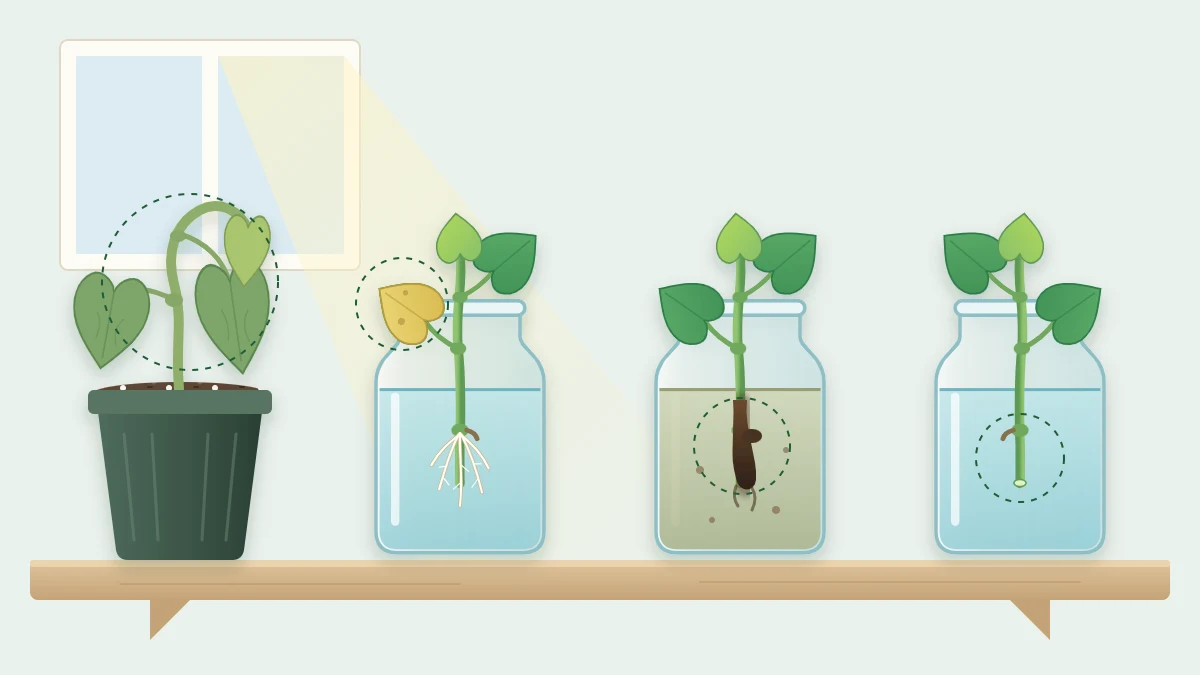
Some cuttings die. That is true for beginners and for people who have propagated plants for decades, and it is the reason the standard advice is to take several cuttings instead of one. A single loss tells you very little.
A run of losses is different, and it is worth asking why cuttings fail when it keeps happening. The causes below are the common ones. Work through them as a checklist, since more than one is often involved at once.
The wrong method for the plant
The most complete kind of failure is a cutting that never could have grown. Propagation methods are specific to the plant, and a method that suits one can be a dead end for another.
- A leaf with no node. On vining plants such as pothos and monstera, a leaf and its petiole alone will not grow into a new plant, even if roots appear. The cutting needs a piece of stem with a node. See what a plant node is and how to find one.
- A cutting from a plant that needs division. Peace lilies and ferns grow from a crown or rhizome and are divided, not grown from stem cuttings. A cut leaf or frond from these plants has nothing to grow from.
If you are not sure which method your plant needs, start with the beginner’s overview of houseplant propagation before cutting again.
A poor start: the stem and the cut
A cutting can only be as strong as the stem it came from. Check these three things.
- The source stem. Cuttings from a weak, stressed or pest-ridden plant begin with low reserves. A flowering stem is also a poor pick, because its energy is going into blooms. Choose a healthy, actively growing stem without flowers or buds.
- The blade. A dull blade crushes the stem instead of slicing it, and a dirty one can carry disease into the wound. Use sharp snips or a knife and clean the blades between plants. Wiping them with rubbing alcohol is a method extension services commonly describe.
- The size of the cutting. A long cutting with many large leaves loses more water than a rootless stem can support. A shorter piece with fewer leaves often holds up better. Large leaves are sometimes reduced in number for the same reason.
Leaves under the surface
Leaves that sit under water in a jar, or buried in the mix, tend to decay, and the decay can spread to the stem. Strip the leaves from the part of the stem that will be submerged or buried. Only bare stem and nodes belong below the line.
Moisture, temperature, light and air
Once the cutting is set up, conditions decide most of what happens next. Each has two ways of going wrong.
- Moisture. Mix that is kept soggy shuts out air and commonly goes with rot. Mix that is allowed to dry out completely leaves a rootless stem with no water at all. Aim for evenly moist, like a wrung-out sponge.
- Temperature. Cold slows root growth, and a cold windowsill in winter is a frequent culprit. A comfortably warm room is a better place.
- Light. Too little light leaves the cutting short of energy. Hot direct sun is the opposite problem, and under a humidity cover it can overheat a cutting quickly. Bright indirect light is the target.
- Air. A humidity cover that is never opened traps still, wet air, which encourages mold and rot. Open it regularly.

Impatience and bad timing
Some failures come from handling, not conditions.
- Pulling cuttings out to check. Lifting a cutting from the mix breaks the fine new roots. Look for new growth, or feel for slight resistance to a very light tug.
- Potting up too early. A cutting moved from water with only a nub of root has little to work with in a pot. Wait until the roots have begun to branch.
- Leaving roots in water too long. At the other extreme, roots left in a jar until they are long and tangled are harder to pot without damage, and the plant can struggle with the change.
Rooting speed varies widely between plants and seasons, so a slow cutting is not automatically a failing one.
Succulents treated like leafy plants
Succulents need nearly the opposite of what a leafy cutting needs. A succulent cutting stood in water, set fresh into wet mix or sealed under a humidity cover is prone to rot. Let the cut end dry and form a callus first, use a gritty mix, and keep it barely moist in open air.
Tip
Take several cuttings and, if you can, set them up in slightly different ways, such as one in water and two in mix. If some survive and some do not, the difference points to the cause.
What you see, and what to check
One sign rarely has one cause. Use this table as a list of possibilities to rule out, starting with the first checks.
| What you see | Possible causes | First checks |
|---|---|---|
| Wilting | Dry air, too many leaves, dried-out mix, hot sun, or a stem base that has started to decay | Feel the mix, look at the stem base, move out of direct sun |
| Yellowing leaf | Normal loss of an older leaf, low light, cold, or the start of rot | Is it only the oldest leaf? Is the stem still firm and pale? |
| Black, soft stem | Rot, often associated with stale water, soggy mix, cold or a damaged cut | Check whether firm tissue and a node remain above the damage |
| Nothing happening | Cold, low light, the season, a slow species, or no node on the cutting | Confirm there is a node, then check warmth and light |
| Mold on the mix | Still, damp air under a cover, mix kept too wet, or decaying leaf litter | Air the cover, remove fallen leaves, let the surface dry slightly |
Two of these have their own guides. For a dark, mushy stem, see why cuttings rot and what to try. For a cutting that stays green and does nothing, see why a cutting is not rooting.
What is normal
Not every change is a problem. It is common for an older, lower leaf to yellow and drop while a cutting roots. The cutting is drawing on that leaf’s reserves and shedding what it cannot support.
If the stem stays firm, the remaining leaves hold their color and the growing tip looks healthy, leave the cutting alone. A slight droop on the first day or two that then eases is also common. Steady decline is what calls for the checks above: more leaves yellowing, a softening stem, or wilting that worsens.
Frequently asked questions
Is it normal for some cuttings to die?
Yes. Some loss is expected even for experienced growers, because cuttings vary and conditions are never perfect. That is why taking several cuttings at once is sensible. A single failure says little, while repeated failures with the same plant suggest the method or the conditions need another look.
Why is my cutting wilting?
Wilting has several possible causes: air that is too dry, too many leaves for a rootless stem to support, mix that has dried out, direct sun, or decay starting at the stem base. Feel the mix and look closely at the base of the stem before deciding what to change.
Should I worry about a yellow leaf on a cutting?
Not on that sign alone. An older, lower leaf yellowing and dropping while a cutting roots is common. It is worth checking further if several leaves yellow, or if the stem feels soft or looks dark at the base, since low light, cold and rot are also possibilities.