Cuttings Rotting in Water or Soil: Causes and What to Try
How to recognize rot on a cutting, the conditions that commonly go with it in water and in mix, how to trim back to healthy tissue, and when it is better to take a new cutting.
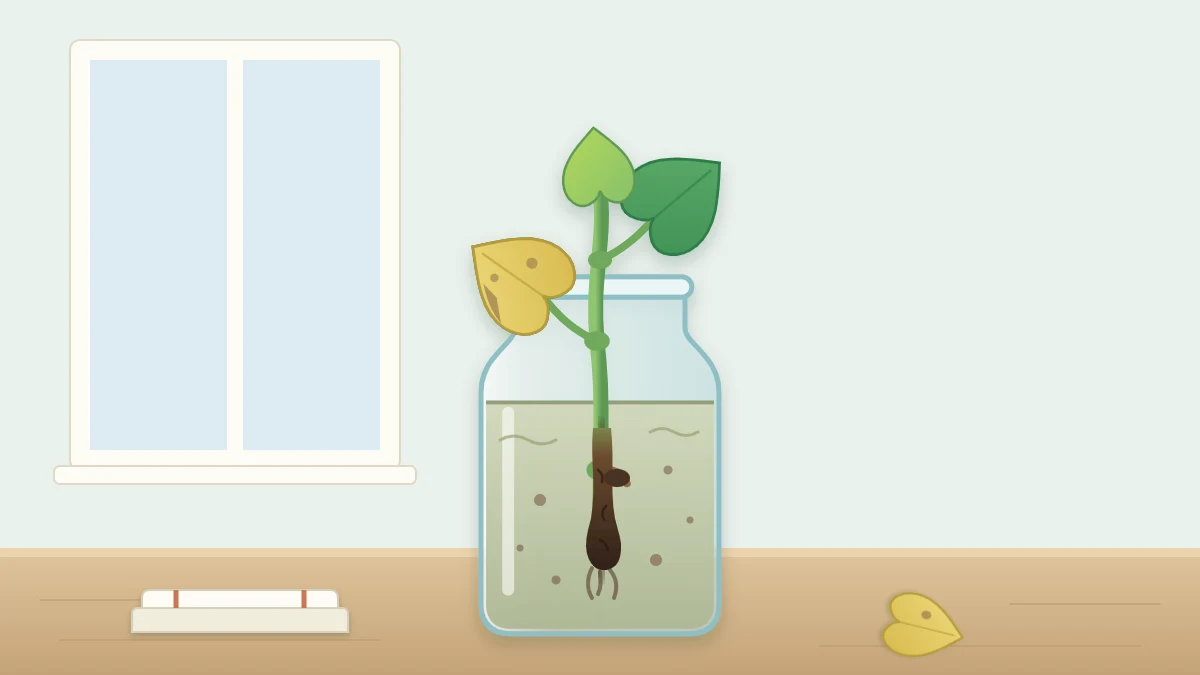
You lift a cutting out of its jar and the end of the stem is dark, soft and slippery. Or a cutting in a pot keels over, and the buried part comes up brown and mushy. Either way, the question is the same: can it be saved?
Sometimes it can. Cuttings rotting at the base are among the most common propagation problems, and whether one recovers depends mainly on how far the damage has spread. This guide covers how to recognize rot, the conditions that usually go with it, what growers commonly try, and when it is better to start over.
What rot looks like
Rot shows first on the part of the stem that is under water or buried in the mix. Look for a combination of these:
- The stem end turns brown or black instead of staying pale and green.
- The tissue is soft and gives way when pressed gently, and it may feel slimy.
- There is sometimes a sour or stale smell.
- In a jar, the water turns cloudy.
- Leaves yellow from the bottom of the cutting upward.
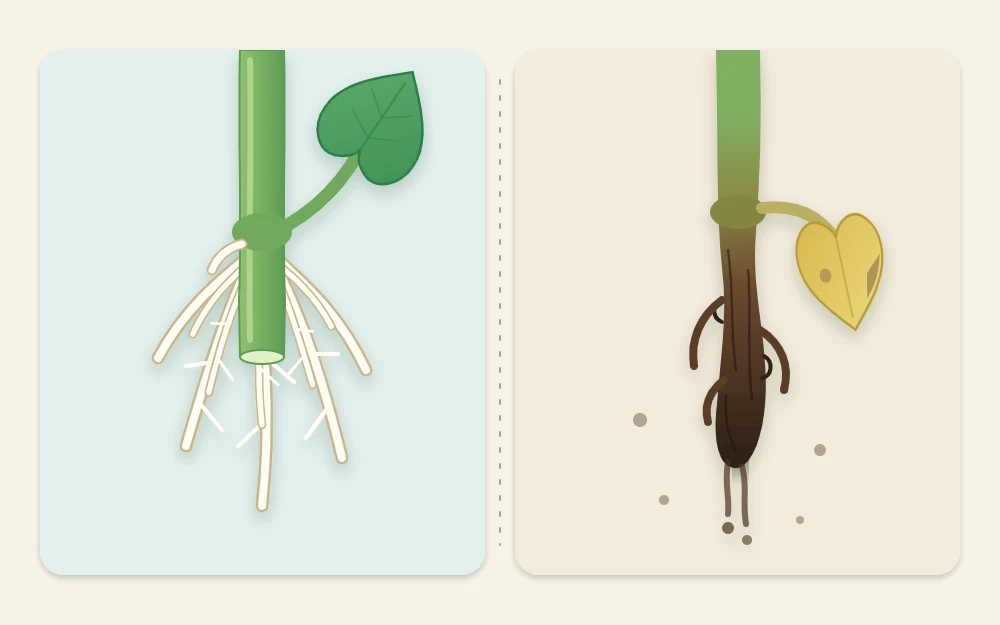
A yellow leaf alone does not tell you much. An older leaf can yellow and drop on a healthy cutting, and low light or cold can cause yellowing too. The stem end is what to look at. If it is firm and pale, rot is unlikely to be the explanation. If it is dark and soft, it probably is.
A slightly darkened, dry, sealed-over cut surface is not the same thing. Many cuttings form a callus at the cut, and it is firm, not mushy.
Conditions that commonly go with rot
Rot is decay, and it takes hold where tissue is damaged, short of air, or surrounded by stale moisture. Several conditions are commonly associated with it, and often more than one is present.
In water
- Stale, warm or cloudy water. Water that sits unchanged loses oxygen and builds up decaying matter.
- Leaves below the water line. Submerged leaves break down and foul the water.
- A dirty container. Residue from an earlier use can carry decay into fresh water.
In mix
- Mix that stays saturated. When every gap is full of water there is no air around the buried stem.
- Cool temperatures with wet mix. Cold slows the cutting while the mix stays wet for longer.
- Buried leaves. Like submerged ones, they tend to decay.
- A sealed humidity cover with no ventilation. Still, wet air encourages mold and rot.
In either
- A crushed cut or a dirty blade. Bruised tissue breaks down easily, and a dirty blade can carry disease into the wound. The guide to making clean cuts covers tools and technique.
- A plant that does not suit the method. Succulents are the clear example. Their cuttings are prone to rot when stood in water or kept in wet mix, and they are usually dried at the cut and then rooted in a gritty, barely moist medium.
What growers commonly try
If there is still healthy stem above the damage, the usual approach is to cut the rot away and start again in cleaner conditions. None of this is certain to work, but it costs little.
- Take the cutting out and rinse the stem so you can see where the damage ends.
- Clean the blade. Wiping the blades with rubbing alcohol is a method extension services commonly describe.
- Cut back to firm, clean, pale tissue above the damage. Look at the cut face. If it shows brown streaks or a dark center, cut a little higher.
- Make sure a node remains. On plants that root from the node, the trimmed cutting still needs at least one node to go below the water or mix.
- Reduce the number of leaves if the cutting is now short. A smaller stem can support less foliage.
- Wash the container or use fresh mix. Do not put the cutting back into the same water or the same wet mix.
- Start again in fresh water or in a more open medium, such as a mix lightened with extra perlite.
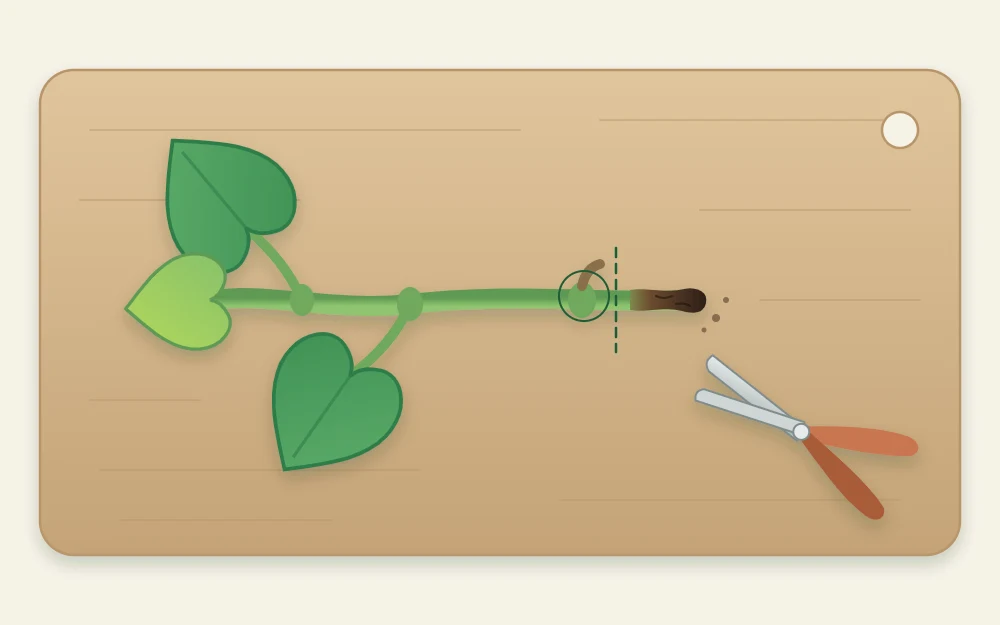
If the cutting rotted in water, the guide to propagating plants in water sets out the routine for keeping a jar fresh. If it rotted in mix, switching to a lighter medium or a smaller pot is often the more useful change.
Good to know
Hydrogen peroxide and similar additives are often suggested for rotting cuttings, but they are not recommended here because the claims made for them are not well supported. Clean tools, fresh water or fresh mix, and more air around the stem are the changes worth making.
When a cutting cannot be saved
There is an honest limit to trimming. If the rot has passed the last node, there is nothing left to root. On plants that root from the node, a length of bare internode or a leaf on its petiole will not make a new plant, however clean the new cut is.
The same applies when the whole stem has gone soft, or when each fresh cut still shows dark tissue inside. At that point it is better to discard the piece and take a new cutting from the parent plant, changing whichever conditions seem most likely to have been involved.
Losing a cutting this way is common and does not mean you did something unusual. It is one reason to take more than one cutting at a time.
Preventing rot next time
- Cut with a sharp, clean blade so the stem is sliced, not crushed.
- Remove every leaf that would sit under water or below the surface of the mix.
- Use a clean jar or pot, and fresh mix from a sealed bag.
- In water, change it every few days or when it looks cloudy.
- In mix, keep it evenly moist like a wrung-out sponge, never soggy, and use a small pot with drainage holes.
- Keep cuttings comfortably warm and off cold windowsills.
- Open humidity covers regularly for fresh air.
- Match the method to the plant, and keep succulents out of water and out of humid enclosures.
Is it rot, or something else?
Not every struggling cutting is rotting. Wilting with a firm, pale stem points toward water loss or too much sun. A cutting that stays green and simply sits there may be cold, short of light or naturally slow. Mold on the surface of the mix can appear without the stem being affected, though it does suggest the air is too still and damp.
If the stem end looks healthy and the trouble is something else, the wider checklist in why cuttings fail goes through the other common causes and how to tell them apart.
Frequently asked questions
Can a rotting cutting be saved?
Sometimes. If firm, pale tissue and at least one node remain above the damage, growers commonly cut the rot away with a cleaned blade and restart the cutting in fresh water or fresh, lighter mix. If the rot has passed the last node, there is nothing left to root and a new cutting is the better option.
Why does my cutting turn black in water?
A black, soft stem end in a jar is commonly associated with water that has gone stale, warm or cloudy, leaves left below the water line, a crushed cut or a container that was not clean. Some plants, succulents in particular, are also poorly suited to rooting in water at all.
Should I add hydrogen peroxide to stop rot?
It is not recommended here, because the claims made for hydrogen peroxide and similar additives are not well supported. The changes more worth making are plain ones: trim back to healthy tissue with a clean blade, wash the container, use fresh water or fresh mix, and give the stem more air.