How to Propagate Plants in Water: A Step-by-Step Guide
A step-by-step guide to rooting a cutting in a jar of water: where the node goes, how to keep the water fresh, what root growth looks like at each stage and how to tell when it is time for soil.
At a glance
What you need
- Clean glass or jar
- Clean sharp snips
- Room-temperature water
- A healthy stem with at least one node
- A spot with bright indirect light
Rooting speed varies by plant, season and conditions.
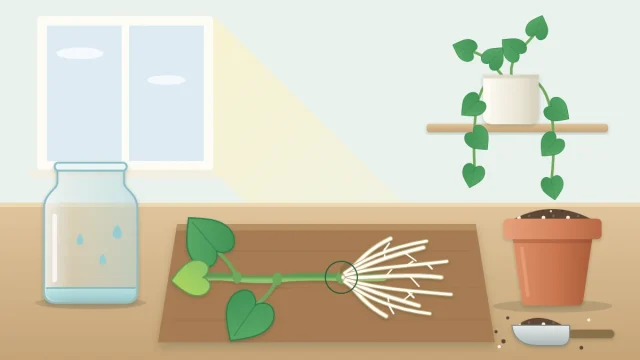
A cutting in a glass of water is where a lot of people begin. You can see everything that happens, there is no mix to keep moist, and the equipment is already in the kitchen. Once you know how to propagate plants in water properly, the main things to get right are where the cut is made, what sits below the water line and how fresh the water stays.
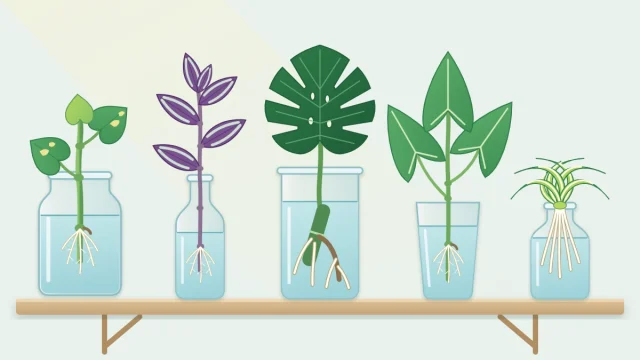
One point comes before the steps. Water rooting suits many soft-stemmed vining plants, such as pothos, heartleaf philodendron and tradescantia, but it does not suit every houseplant. Succulents tend to rot when kept wet, and clump-forming plants such as peace lily have no stem to cut in the first place. If you are unsure about yours, check the list of houseplants that root in water before you cut.
What you need
- A clean glass or jar. Wash it with dish soap and rinse it well. A narrow neck helps hold the cutting upright.
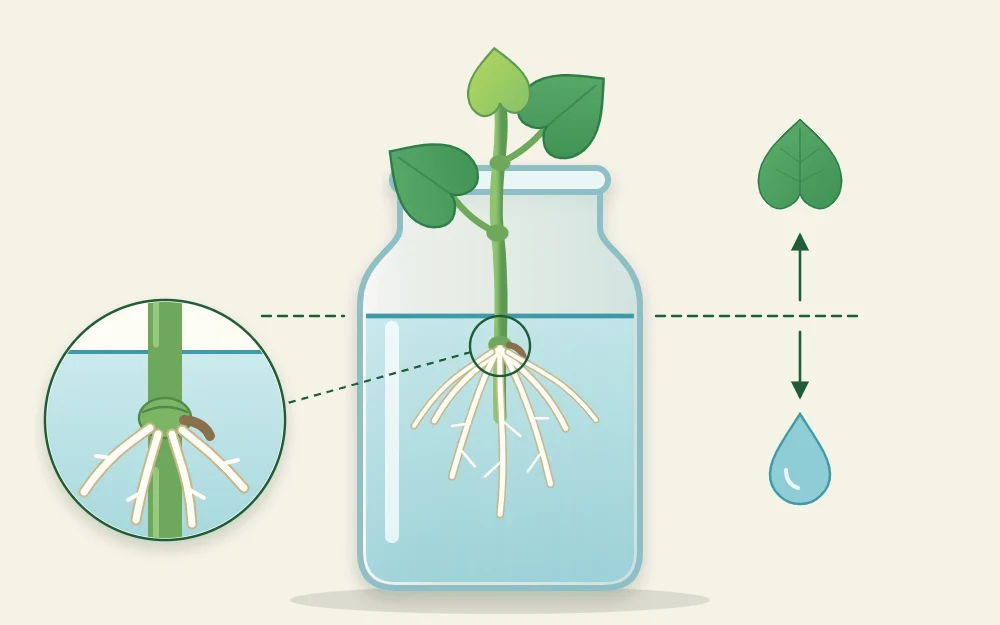
- A cutting with at least one node. The node is the joint where a leaf meets the stem, and it is where the roots will form.
- Clean, sharp snips or scissors.
- Room-temperature water.
- A bright spot out of direct sun.
Rooting hormone is optional and is not needed for the plants this method suits best. Many common vining houseplants root in plain water without it. If you do use a product, read and follow its label.
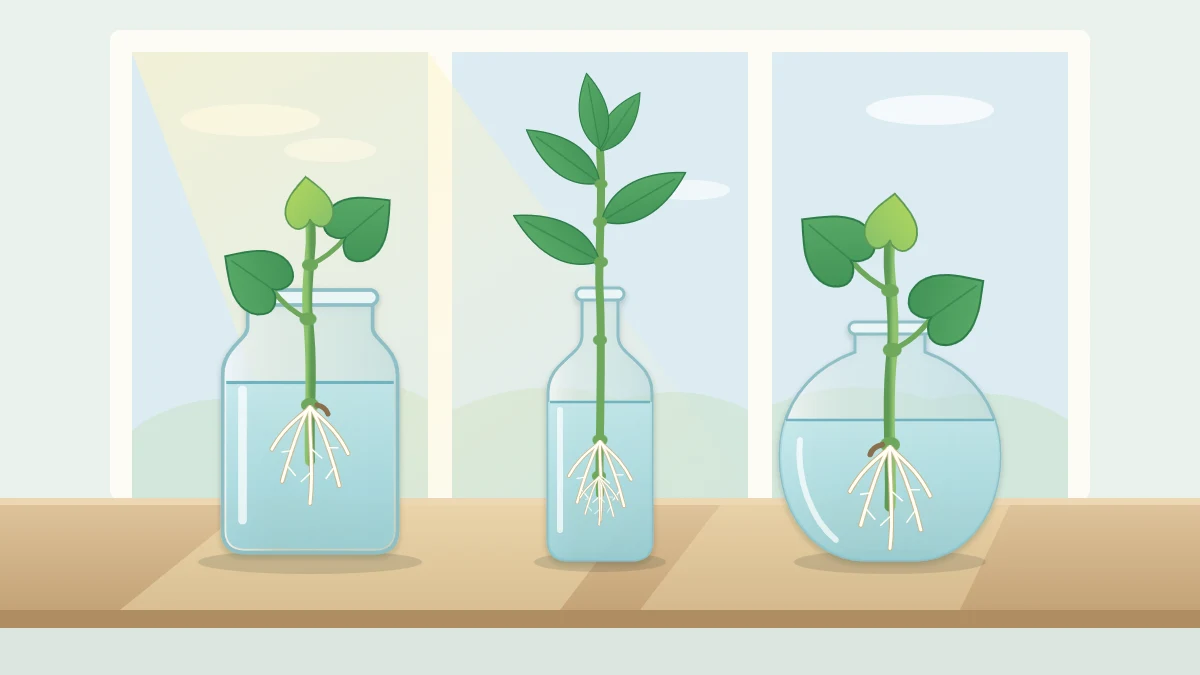
Clear glass or opaque container
Either works. Clear glass lets you watch the roots develop and see at a glance when the water has turned cloudy, which is useful when you are learning. Its drawback is that light reaching the water encourages green algae on the inside of the glass.
An opaque container, such as a ceramic mug or a tinted bottle, slows algae because less light gets in, but you have to lift the cutting out to check on it. Algae looks untidy more than anything, so for a first attempt clear glass is a reasonable choice.
How to root a cutting in water, step by step
- Take the cutting. Choose a healthy stem and cut a little below a node, so the cutting carries at least one node and one or two leaves. A piece with two or three nodes gives you a spare.
- Clear the lower stem. Remove any leaf that would sit under water. Submerged leaves break down and foul the water.
- Fill the jar. Use room-temperature water. Very cold water straight from the tap can be a shock to a tropical cutting.
- Set the depth. Place the cutting so the node is under water and every leaf is above it. You do not need a deep jar of water: covering the node by about 1 in (2.5 cm) is enough.
- Find the right spot. Put the jar in bright indirect light, out of hot direct sun. Sun through glass heats a small volume of water quickly and can scorch the leaves.
Take more than one cutting if the parent plant can spare them. Some cuttings fail even when everything is done well, and a few in the same jar improve your odds of ending up with at least one rooted plant.
Looking after the water
The water is the cutting’s whole environment, so most of the care is about keeping it clean.
- Top up as the level drops. Water evaporates and the cutting drinks some of it. Do not let the node end up above the surface.
- Replace the water when it looks cloudy. Many growers also refresh it every few days to a week as a habit, cloudy or not.
- Rinse the jar if a film builds up. A slippery coating on the glass or on the stem can be rubbed off gently under running water before you refill.
Keep the jar somewhere comfortably warm. A cold windowsill in winter slows everything down, and so does a dim corner. If you want more background on cuttings in general, see Iowa State University Extension on propagating houseplants from cuttings.
What you may see as roots form
Root growth follows a recognizable order, even though the pace differs a great deal.
- Pale bumps at the node. Small, light-colored swellings appear on the submerged stem. On some vines, an aerial root nub that was already there begins to lengthen.
- White roots. The bumps extend into smooth white roots that grow down into the water.
- Branching. Side roots appear along the first ones, and the root system starts to look like a small tassel.

There is no fixed timeline. Some plants show roots quickly in warm, bright conditions, and others take much longer, particularly in the darker months or when the parent plant was not in strong growth. Judge by what the cutting looks like, not by the calendar. As long as the stem is firm and the leaves hold their color, a slow cutting is still a live one.
When to move the cutting to soil
Go by root development. A cutting is generally ready for potting up when it has several roots that have begun to branch. A single short root is too little to support the plant in mix, and a very long, tangled mass is awkward to pot without breaking.
The move itself has its own technique, because roots formed in water need a short adjustment to life in a pot. The guide to moving water-rooted cuttings to soil covers pot size, mix and the first few weeks.
Tip
If several cuttings share a jar, lift them apart every so often while the roots are short. Roots from neighboring cuttings tangle as they lengthen and are hard to separate later without damage.
If something looks wrong
Three things are worth acting on promptly: a stem that feels slimy, an unpleasant smell, and water that turns cloudy again soon after you change it. Each has more than one possible cause, from a leaf left under water to a cutting that was already damaged.
As a first response, take the cutting out, rinse it, wash the jar and refill it with fresh water. If part of the stem is soft, the article on cuttings that are rotting explains how to tell what is going on and whether the cutting can be saved.
A leaf that yellows and drops while the stem stays firm is a milder matter. A cutting with no roots sometimes sheds an older leaf, and that alone does not mean it has failed.
Frequently asked questions
How often should I change the water for a cutting?
Replace it whenever it looks cloudy, and top it up when the level falls so the node stays covered. Many growers also swap it for fresh water every few days to a week as a routine. Rinse the jar at the same time if the glass feels slippery.
Why has my cutting not grown roots yet?
Slow rooting has several possible causes. Check that a node is actually under water, that the spot is bright and reasonably warm, and that the plant is one that suits water rooting. Season and the health of the parent matter too. A firm stem with healthy leaves is still alive and may simply need longer.
Do I need rooting hormone for water propagation?
No. It is optional, and many common vining houseplants such as pothos and heartleaf philodendron form roots in plain water without it. It may help with plants that are slow or hard to root. If you choose to use a product, read and follow the label.