How to Take Stem Cuttings From Houseplants
The exact steps for a first stem cutting: which houseplants suit the method, where to cut in relation to the node, which leaves to remove and where to root the piece afterward.

At a glance
What you need
- Clean sharp snips or a knife
- Rubbing alcohol for the blades
- Glass jar of room-temperature water
- Small pot of moist rooting mix
- Healthy parent plant
Rooting speed varies by plant, season and conditions.
A stem cutting is a piece of stem, with its leaves and at least one node, removed from a parent plant so it can grow roots of its own. Once you know how to take stem cuttings, one overgrown vine can become several new plants, and the parent usually looks tidier for the trim.
The method is simple, but it is not universal. It depends on the plant having a real stem with nodes along it, so the first job is checking that your plant is the right kind. The cutting itself is a few minutes of work.
Which houseplants suit stem cuttings
Stem cuttings suit vining and branching houseplants that have visible nodes spaced along a stem. Common examples include:
- Pothos and heartleaf philodendron
- Tradescantia
- Hoya
- Coleus
- Monstera
- Many peperomias
- Rubber plant and dracaena, as larger, thicker-stemmed examples
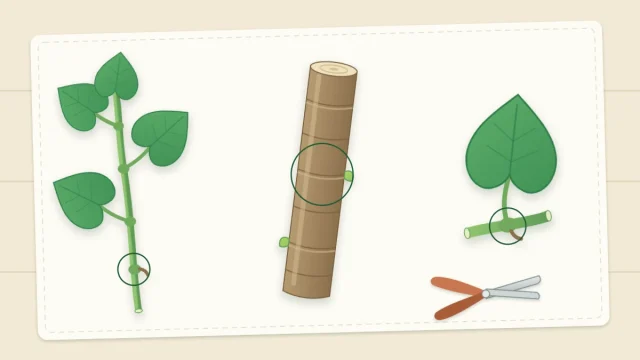
Each of these has stretches of stem between its leaves, and each joint on that stem is where new roots and shoots can form. If you are not sure where the joints are on your plant, read about what a plant node is and how to find one before you pick up the snips.
Plants that are divided instead
Some houseplants grow from a crown at soil level. Their leaves rise straight from the base, with no stem between them. Peace lily, most ferns and spider plant are built this way.
These plants do not suit stem cuttings, because there is no length of stem to cut, and a single leaf pulled from the crown will not grow into a new plant. They are divided instead: the clump is separated into smaller pieces that each keep some roots and leaves.
The same logic applies to vines. A pothos or monstera leaf cut off with only its petiole, and no node, may stay green for a while but has nothing to grow a new stem from.
What to gather first
- Clean, sharp snips, scissors or a knife
- A glass jar of room-temperature water, or a small pot of moist rooting mix
- A healthy parent plant in active growth, which for many houseplants means spring and summer
A sharp blade matters more than the type of tool. A dull one crushes the stem instead of slicing it, and crushed tissue is more likely to decay. Wiping the blades with rubbing alcohol before you start, and between plants, is a method extension services commonly describe. There is more on tools and technique in the guide to making clean cuts.
Taking the cutting, step by step
- Choose a healthy stem. Look for firm growth with good color and no pests or damage. Skip stems that are limp, yellowing or flowering heavily.
- Count the nodes. Working back from the tip, a common guide is a piece with two to four nodes. Adjust this to the plant: a small-leaved vine may fit four nodes into a short piece, while a monstera cutting may carry only one or two.
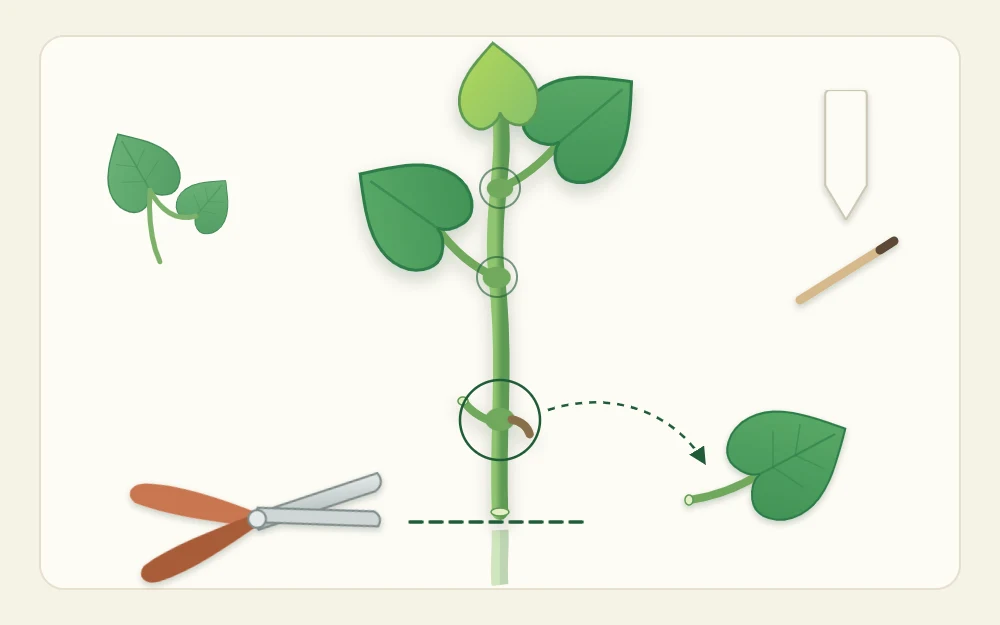
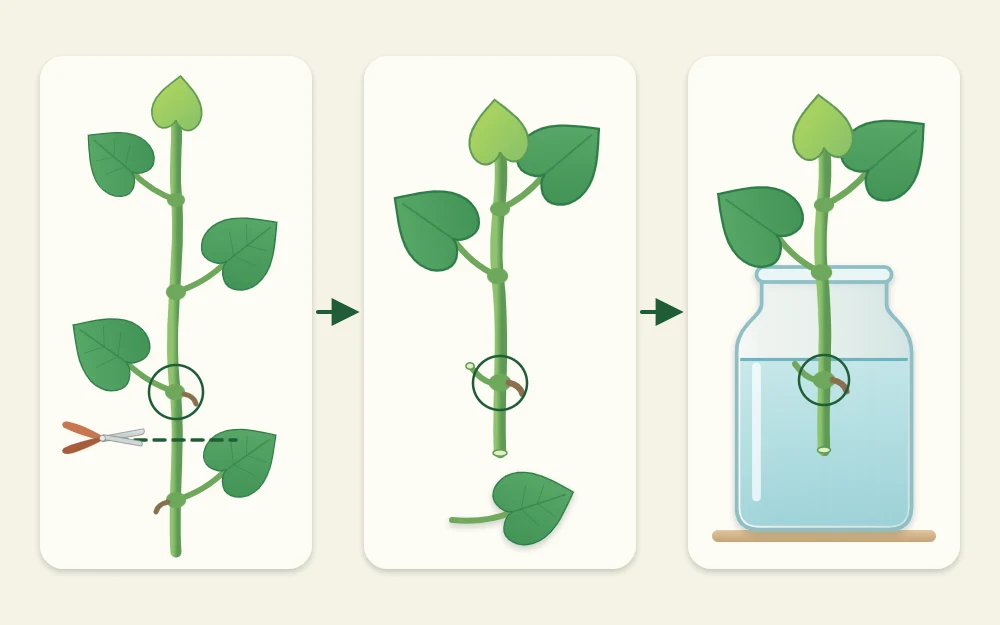
- Cut a little below a node. Make one clean cut just under the lowest node you want to keep. That node will sit in the water or mix, and it is where roots are expected to form.
- Remove the lower leaves. Take off any leaf that would end up under water or below the surface of the mix, so that no leaf is buried. Snip or pinch it off close to the stem without tearing the stem itself.
- Keep leaves on top. Leave at least one or two leaves at the upper end. They keep the cutting fed while it has no roots.
- Move it to water or mix promptly. A soft, leafy cutting wilts quickly if it lies on a table.
What about large leaves?
Big leaves lose more water than a stem without roots can easily replace. You may come across advice to cut large leaves in half. There is no need to rely on a trick: you can leave the leaves alone, or simply keep the cutting shorter so it carries fewer of them.
Choose where to root it
A prepared cutting can go into water or into a moist rooting mix. Both are widely used for the plants listed above, and each has its own guide.
- Water. Stand the cutting in a jar so the lowest node is submerged and the leaves stay dry. You can watch what happens at the node, which makes it a popular first method for pothos, heartleaf philodendron and tradescantia. See how to propagate plants in water.
- Rooting mix. Insert the cutting into an airy, evenly moist mix so the lowest node is just covered. The roots form in the medium they will keep growing in, so there is no move from water later. See how to root cuttings in soil.
Either way, give the cutting bright indirect light and keep it out of hot direct sun. Rooting hormone is optional. Many common houseplants, pothos among them, root without it; if you decide to use one, read and follow the product label.
Speed depends on the species, the season, the temperature and the health of the parent plant, so watch the cutting rather than the calendar. In water, look for pale bumps at the node and then white roots that begin to branch. In mix, look for new leaf growth and gentle resistance when you give the stem a light tug. Iowa State University Extension has more detail on growing houseplants from cuttings.
What happens to the parent plant
The stem you cut does not stay bare forever. The parent usually branches from a node below the cut, which is why trimming a long, leggy vine often leaves it looking fuller.
Cut where you would like new growth to start, and leave the parent plenty of leaves.
Take more than one cutting
Not every cutting roots, even from an easy plant and with careful handling. Some simply sit, and some soften and decay at the base. Taking a few cuttings at once is the sensible approach: the losses matter less, and you can compare how each one responds.
Tip
If you are trimming a long vine anyway, turn the whole length into several cuttings rather than one. Each piece needs its own node and at least one leaf.
Frequently asked questions
Where exactly do I cut a stem cutting?
Cut a little below a node, the joint where a leaf meets the stem. That node ends up in the water or rooting mix and is where roots are expected to form. A piece cut between two nodes with no node at its base has much less to work with.
How many leaves should a stem cutting have?
Keep at least one or two leaves at the top and remove any that would sit under water or be buried in the mix. A common guide is a piece with two to four nodes, adjusted to the plant, so a large-leaved cutting is often shorter than a small-leaved one.
Can I take a stem cutting from a peace lily or a fern?
No. Peace lily, most ferns and spider plant grow from a crown at soil level and have no stem between their leaves, so there is nothing to cut. These plants are divided instead, by separating the clump into smaller pieces that each keep roots and leaves.