How to Propagate a Snake Plant: Division vs. Leaf Cuttings
Dividing a snake plant gives a sizable plant that keeps its yellow edge, while leaf sections are slow and usually come back plain green. Compare both methods and follow the division steps.

At a glance
What you need
- Clean sharp knife
- Rubbing alcohol for the blade
- Fast-draining potting mix
- Small pots with drainage holes
- Newspaper or a tray to work on
Rooting speed varies by plant, season and conditions.
A snake plant that has filled its pot with tight fans of leaves, or pushed a new shoot against the rim, is ready to be multiplied. The question is which way to do it, because the two options give quite different results.
If you are working out how to propagate a snake plant (Dracaena trifasciata, long sold as Sansevieria), the choice is between dividing the plant and rooting sections of a leaf. This guide compares the two, walks through division, and explains why a yellow-edged plant often produces plain green offspring from leaf cuttings.
Methods that suit a snake plant, and one that does not
Two methods suit this plant:
- Division of the thick underground rhizomes, which includes separating pups. It gives you a sizable plant at once and keeps the leaf pattern of the parent.
- Leaf section cuttings, rooted in mix or in water. One leaf yields several cuttings, but they are slow.
Stem cuttings do not apply. A snake plant has no above-ground stem to cut: the leaves rise directly from rhizomes below the soil, so there are no nodes along a vine to work with.
Division vs. leaf cuttings at a glance
| Method | What you get | Relative speed | Keeps the yellow edge? |
|---|---|---|---|
| Division of rhizomes | A sizable plant with its own roots right away | Fastest route to a finished plant | Yes |
| Separating a pup | A small rooted plant | Fast to establish, slow to gain size | Yes |
| Leaf sections in mix | Several small new shoots from one leaf | Slow | Generally no |
| Leaf sections in water | The same, with visible roots | Slow, with more risk of rot | Generally no |
If your plant is crowded and you want another plant that looks like it, divide it. If you have a single leaf to spare, or want many small plants and do not mind waiting, leaf sections are worth a try.
How to divide a snake plant
- Slide the plant out of its pot. A tightly packed root ball may need the pot squeezed or a knife run around the inside edge.
- Shake or brush away enough mix to see the rhizomes. They are the thick, orange-tan underground stems joining one fan of leaves to the next.
- Cut through the rhizome with a clean, sharp knife so each piece has roots and at least one fan or pup. Rubbing alcohol on the blade is a method extension services commonly describe.
- Let the cut surfaces dry for a day or so in a shaded, airy spot.
- Pot each piece in fast-draining mix, at the same depth it was growing before, in a pot only a little wider than its roots.
- Water sparingly. Let the mix become nearly dry before you add more, because a freshly cut rhizome that sits wet is prone to rot.

Pups are handled the same way. A pup that already has a few leaves and roots of its own is easier to establish than one that has only just broken the surface. The general technique for splitting root balls, for this and other clumping plants, is covered in how to divide houseplants.
Leaf section cuttings in brief
For leaf cuttings, a healthy leaf is cut crosswise into sections a few inches long. The cuts are left to dry for a day or so, and each section is then set upright in barely moist, fast-draining mix with its lower end about 1 in (2.5 cm) deep.
The rule that matters most is orientation. Each section roots only from the end that was nearer the base of the plant. A section set upside down will not root. Because the pieces look alike once they are cut, mark the bottom of each one as you go, for example by cutting a small notch or a shallow V into the lower edge.
The new plant does not grow from the old leaf itself. Roots form at the base first, and later a small shoot emerges from the mix beside the section. The complete method, with cutting sizes and aftercare, is in the guide to leaf section cuttings.
Rooting leaf sections in water
Water rooting is possible. Stand the section so only the bottom end is shallowly submerged, and replace the water every few days or when it turns cloudy. Rot is more common this way than in mix, so check the submerged end often and trim back to firm tissue if it turns soft.
Why yellow-edged plants come back plain green
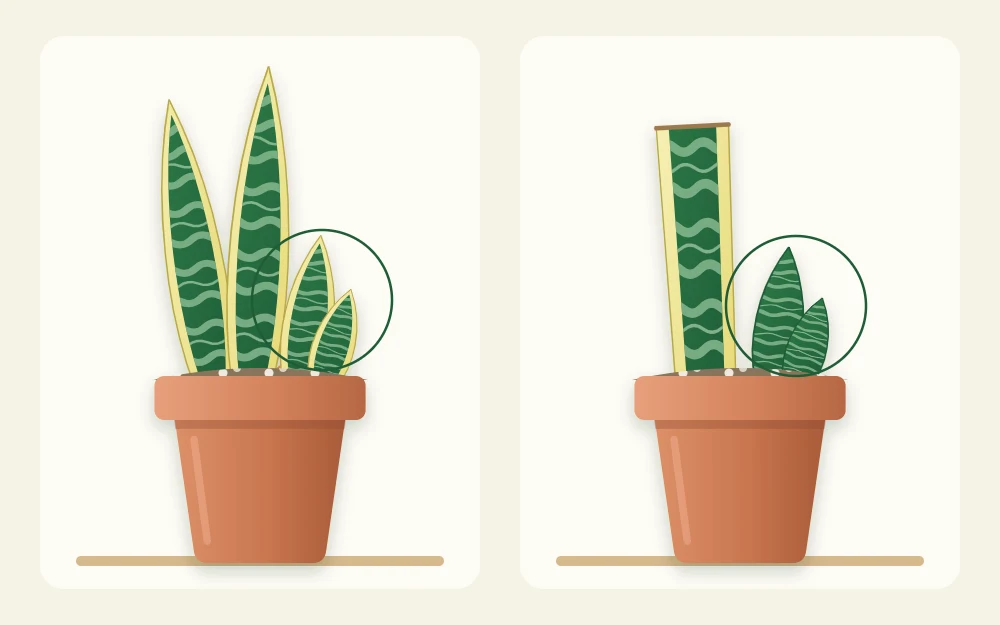
Varieties with yellow leaf margins hold a surprise. Leaf sections taken from them generally give plain green plants, because the edge color is not carried by the tissue that forms the new shoots. The cutting is healthy, and nothing has gone wrong. The new plant simply lacks the yellow band.
Division avoids this, since each divided piece is a complete part of the original plant with its growing points intact. To keep the yellow edge, divide.
Expect slow progress with either method
This plant is slow in every method, and slower still in low light and cool rooms. No honest timeline exists for it. Place divisions and cuttings in bright indirect light in a warm room and judge them by condition: leaves or sections that stay firm and keep their color are doing fine, even when nothing appears to change.
Rooting hormone is optional for leaf sections. It may help with slow-rooting plants, but snake plant sections commonly root without it. If you use one, read and follow the product label. Some sections fail whatever you do, so it is sensible to start several.
If you like slow, sturdy plants with underground storage organs, the method for a ZZ plant, which is divided or grown from leaf cuttings, follows a similar logic.
A note for homes with pets
Good to know
The ASPCA lists snake plant as toxic to dogs and cats; see the ASPCA entry for snake plant. Keep cut leaves, drying sections and jars of cuttings where pets cannot chew them.
Drying cuttings are easy to overlook on a low shelf or counter, so pick a spot for them before you start cutting.
Frequently asked questions
Why did a yellow-edged snake plant cutting grow plain green?
That is the expected result with leaf sections. The yellow margin is not carried by the tissue that forms new shoots, so plants raised this way are generally all green. Nothing went wrong with the cutting. To keep the yellow edge, divide the rhizome instead, so each new plant is a complete piece of the original.
Can you root a snake plant leaf in water?
Yes, it is possible. Stand the leaf section with only its bottom end shallowly submerged and keep the water fresh. Rot is more common in water than in fast-draining mix, so check the submerged end regularly. Make sure the end in the water is the one that was nearer the base of the plant.
When is a snake plant pup big enough to separate?
There is no fixed size, but a pup with a few leaves and some roots of its own settles in more easily than one that has just emerged. Unpot the plant to check. If the pup has roots, cut the rhizome joining it to the parent, let the cut dry, and pot it up.