How to Divide Houseplants Step by Step
Find out which houseplants can be split and which cannot, then follow clear steps to take a crowded clump out of its pot, separate the crowns and settle each division into its own pot.

At a glance
What you need
- Clean sharp knife
- Fresh potting mix
- Pots with drainage holes
- Paper to cover the table
- Watering can
Rooting speed varies by plant, season and conditions.
Division is the most direct way to get a second plant: you take one crowded clump out of its pot and split it into two or more pieces that already have roots and leaves. Nothing has to grow roots from scratch, which is why it is often the first method beginners try. Learning how to divide houseplants is mostly a matter of knowing where a plant naturally comes apart.
The catch is that only some plants are built for it. Before you reach for a knife, look at how your plant meets the soil. That one check tells you whether division is possible at all.
Which plants can be divided
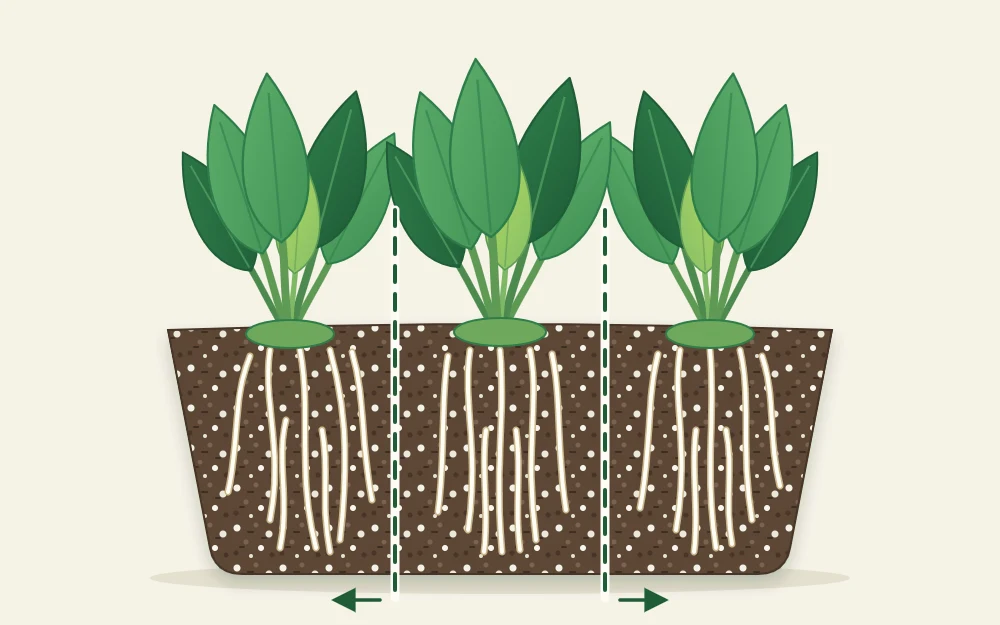
A plant can be divided when it grows as several separate crowns or stems rising from the soil, or when it spreads by a rhizome, a thick stem that creeps along or just under the surface. Each crown is its own growing point with its own roots, so it can live apart from the rest.
Common houseplants that grow this way include:
- Peace lily
- Boston fern and other clumping ferns
- Snake plant
- ZZ plant
- Spider plant
- Calathea and prayer plant
- Cast iron plant
- Chinese evergreen
- Asparagus fern
Snake plant is a good example of a rhizome grower, and it can be multiplied in more than one way. The snake plant propagation guide compares division with leaf cuttings for that plant.
Which plants cannot be divided
A plant with one single stem or trunk has nothing to divide. Rubber plant, a single-cane dracaena, fiddle-leaf fig and a lone monstera stem all rise from one point, and cutting down through that point does not give you two plants. It gives you one badly damaged one. These plants need stem cuttings or air layering instead.
Pots can be misleading here. Growers often plant several rooted cuttings together to make a fuller pot, so what looks like one bushy plant may be three separate single-stem plants. Those can be untangled and potted individually, but that is separating neighbors, not dividing a clump.
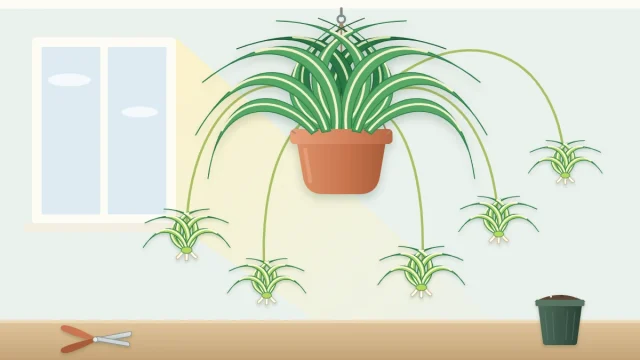
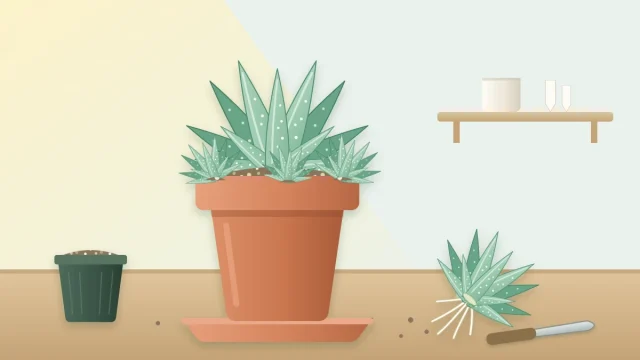
Two related situations have their own guides. If your plant has small, complete baby plants at its base, see how to separate offsets and pups. If it dangles miniature copies of itself on long stems, as a spider plant does, see rooting plantlets and runners.
When to divide
Divide when the plant is actively growing, which for many houseplants means spring and summer. A plant that is already pushing out new leaves and roots repairs the damage of division more readily than one that is resting in the darker months.
Signs that a clump is ready include crowns pressed tight against the pot wall, roots circling the inside of the pot, and a center that looks crowded or thin. A small plant with only one or two crowns is better left alone until it fills out.
How to divide a houseplant step by step
Set out a clean, sharp knife, fresh potting mix and pots with drainage holes before you start, and cover the table with paper. Roots dry quickly in open air, so it helps to have everything within reach.
- Water a day or so ahead. Moist roots bend instead of snapping, and the root ball slides out more easily.
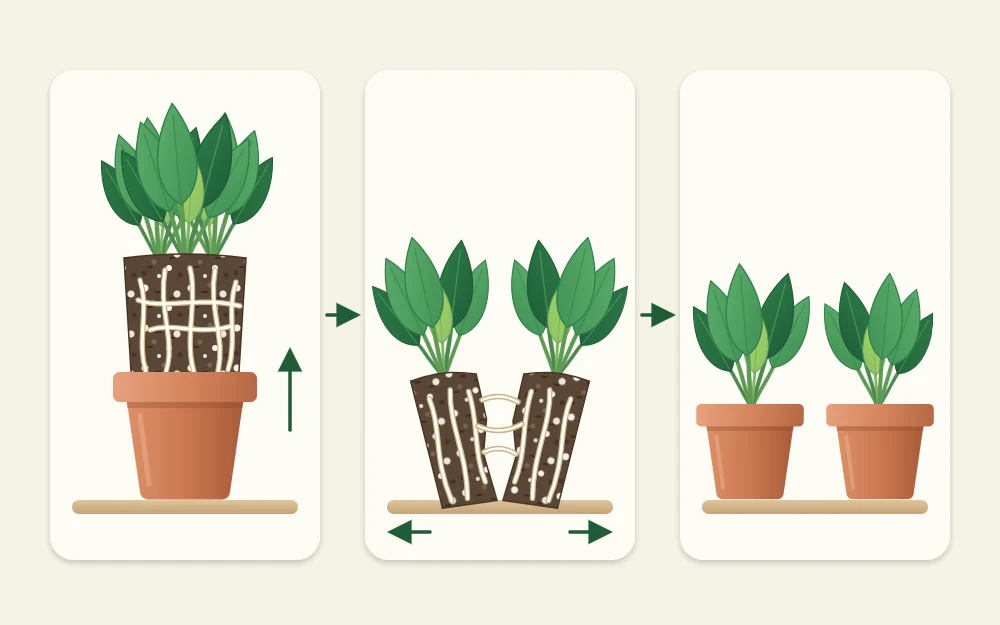
- Slide the plant out. Tip the pot on its side, support the base of the stems and ease the root ball free. Squeeze or tap the pot if it sticks.
- Loosen the mix. Work your fingers into the root ball and shake off enough mix to see where the crowns separate. You do not need bare roots, only a clear view.
- Tease the crowns apart by hand. Start at a natural gap and pull gently in opposite directions, untangling roots as you go. Some will break, and that is expected.
- Cut where pulling fails. Tough roots and thick rhizomes often will not part by hand. Slice through them with the knife in one firm stroke rather than sawing. The guide to making clean cuts covers blades and cleaning them.
- Check each division. Every piece needs its own roots and at least one growing point, meaning a crown, a shoot or a bud on the rhizome.
- Pot each piece. Set it at the same depth it grew before, in fresh mix, in a pot that fits its roots with a little room to spare. Firm the mix lightly.
- Water in. Water until it drains from the bottom so the mix settles around the roots.
How many pieces to make
It is tempting to split a big clump into as many plants as possible. Resist that. Larger divisions recover faster than tiny ones because they keep more roots to support their leaves, while a single small crown with a few root strands has little in reserve.
For a first attempt, halves or thirds are a sensible choice. You can always divide again another year once the pieces have filled their pots.
Tip
Avoid oversized pots. A small division sitting in a large volume of wet mix stays damp around the roots for a long time. Choose a pot only slightly wider than the root mass.
Aftercare for new divisions
A fresh division has lost some of its roots but none of its leaves, so for a while it can take up less water than it uses. Some drooping is common at first, and an older leaf or two may yellow. That alone is not a reason to worry.
- Light: bright indirect light, away from hot direct sun, which pulls water out of the leaves faster than the reduced roots can replace it.
- Moisture: keep the mix evenly moist, like a wrung-out sponge, and never soggy. Check with a finger rather than watering by the calendar.
- Feeding: hold off on fertilizer for a while. Fresh mix carries enough for the first stretch, and damaged roots do not need the extra salts.
The sign you are waiting for is new growth: a fresh leaf unfurling or a new shoot at the base. Once you see that, treat the division like any other plant of its kind. As for general repotting care, the usual rules apply: a pot with drainage and a mix suited to the species.
If a division struggles
Not every piece takes, and a limp division has several possible causes. Check the simple things first. Mix that stays wet for days is one possibility, and a pot that is too large often goes with it. Mix that has dried out completely is another. Strong sun or a cold draft can also hold a new division back.
If a piece turned out to have very few roots, you can remove one or two of the oldest leaves to reduce the demand on it, keep it out of direct sun and give it time. For more detail on division and other methods, see the NC State Extension Gardener Handbook chapter on propagation.
Frequently asked questions
Can I divide a plant that has only one stem?
No. A plant that rises from a single stem or trunk, such as a rubber plant, fiddle-leaf fig or single-cane dracaena, has only one growing base, so there is nothing to separate. Cutting through it damages the plant. These plants are multiplied with stem cuttings or air layering instead.
Why is my plant drooping after I divided it?
Some drooping is common. A division loses part of its root system but keeps its leaves, so for a while it may take up less water than it uses. Keep it in bright indirect light with evenly moist mix. If drooping continues, check whether the mix is staying soggy or has dried out.
How small can a division be?
Each piece needs its own roots and at least one growing point, such as a crown or a bud on the rhizome. That is the minimum. Larger pieces with several crowns and a good share of roots tend to recover faster, so halves or thirds are a sensible choice for a first attempt.