Plantlets and Runners: Rooting Baby Plants Still on the Parent
Spider plants, strawberry begonias, mother of thousands and piggyback plants grow miniature copies of themselves. Here is how to root those plantlets, attached to the parent or detached.
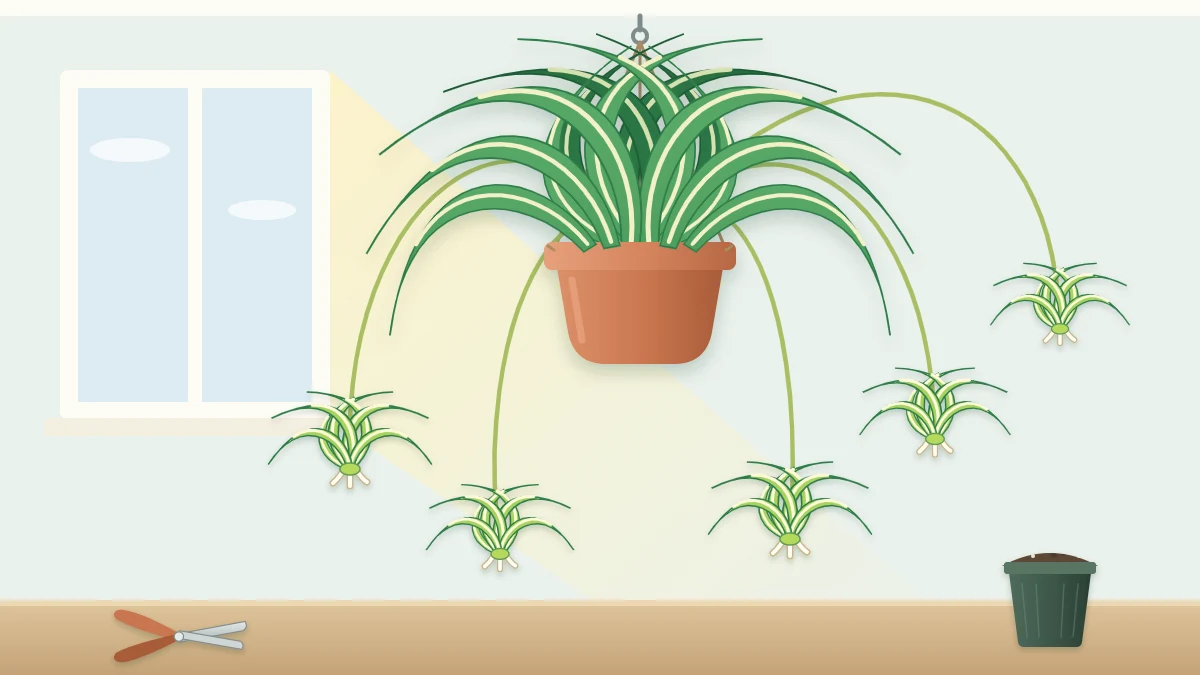
A few houseplants produce miniature copies of themselves well away from the soil: at the ends of long stems, along thread-like runners, or even on their own leaves. These little plants are waiting for a patch of mix to land on. If you understand how plantlets and runners work, you can turn them into new plants with very little risk.
The idea is simple. A plantlet is a small, complete plant, and a runner is the stem that carries it out from the parent. You can root the plantlet while it is still connected, or snip it off and root it on its own. Both approaches are described below, along with the plants they apply to.
Plants that make plantlets away from the base
This is a short list, and the method belongs to these plants and others that behave like them:
- Spider plant: plantlets form at the ends of long arching stems, often several to a stem.
- Strawberry begonia (Saxifraga stolonifera): thin, thread-like runners trail from the parent with a small plant at each tip.
- Mother of thousands: tiny plantlets line the leaf edges, then drop and root where they fall.
- Piggyback plant: new plantlets grow on top of mature leaves, at the point where the leaf meets its stalk.
Baby plants that come up from the soil right beside the parent are a different thing. Those are offsets, and the guide to separating offsets and pups explains how to handle them.
Rooting a plantlet while it is still attached
This is the lowest-risk method. The runner keeps delivering water and food from the parent, so the plantlet does not have to survive on its own while it grows roots. If it is slow, nothing is lost.
- Fill a small pot with moist potting mix and set it beside the parent, close enough that the runner reaches without being stretched tight.
- Rest the base of the plantlet on the surface of the mix. Do not bury the leaves. The base only needs to touch.
- Hold it in place with a bent paper clip or a hairpin pushed over the runner just behind the plantlet. Good contact with the mix matters more than depth.
- Keep the mix lightly moist. A small pot dries faster than the parent’s pot, so check it separately.
- Leave the runner alone until the plantlet resists a gentle tug and is clearly producing new leaves. Then cut the runner close to the plantlet and remove the pin.

For a piggyback plant, the same idea applies to a whole leaf: lay a leaf that carries a plantlet flat on the mix, still attached to the parent, and pin it so the plantlet sits against the surface.
How long this takes depends on the plant, the season, and the warmth and light available. Go by the tug test and the new growth, not by a date.
Detaching first, then rooting
Sometimes there is no room for extra pots around the parent, or a hanging plant makes the pinning method awkward. In that case you can remove the plantlets and root them separately. They are on their own from the moment you cut, so choosing well matters.
Pick plantlets that already show root nubs at the base: small, pale, blunt bumps on the underside. A plantlet with nubs is ready to make roots. A very young one with a smooth base is better left on the parent to develop.
Snip the runner with clean scissors, leaving a short stub. Then use one of two routes:
- In water: set the plantlet in a small glass so that only the base touches the water and the leaves stay dry. Replace the water when it looks cloudy. Pot the plantlet once it has several roots that have begun to branch.
- In mix: press the base into moist potting mix and keep it evenly moist, like a wrung-out sponge. The general technique is the same as for cuttings and is covered in how to root cuttings in soil.
Spider plant is the one most people start with, and its full routine, from choosing plantlets to potting them, is in the spider plant propagation guide. The University of Wisconsin Extension article on spider plant has more background on the plant itself.
Take a few more plantlets than you need. Some fail to root, particularly small ones, and extras cost the parent very little.
Planting several together for a full pot
A single plantlet in a pot looks sparse for a long time. For a fuller plant sooner, set three or more plantlets in the same pot, spaced evenly, a little way in from the rim. As they grow, their leaves fill in and the group reads as one plant.
This works with both methods. You can pin several runners into one wider pot beside the parent, or root detached plantlets and combine them when you pot them up.
Mother of thousands needs containing
Mother of thousands rarely needs help. Its plantlets often have tiny roots before they fall, and they root wherever they land. To propagate it, lift a few gently from the leaf edge and set them on the surface of a gritty, barely moist mix. It is a succulent, so keep it on the dry side.
Good to know
Fallen plantlets from mother of thousands can spread into neighboring pots and take hold there. Keep the plant a little apart from others, and clear dropped plantlets from nearby pots while they are still small enough to lift out easily.
Why this only applies to plants that make plantlets
A plantlet is already a small plant, with a growing center and the ability to form roots. That is why laying it on soil is enough. The parent has done the difficult part.
The same trick does not carry over to plants that do not make plantlets. On most houseplants, a leaf or stem tip pinned to soil will not turn into a new plant, because an ordinary leaf has no growing point of its own to build from.
There is one related exception. Some vines form roots where a node touches moist soil, so pinning a length of stem into a neighboring pot can produce a rooted section. That is layering. It relies on the node, not on a plantlet, and it only suits vining plants with nodes along the stem.
After the plantlet is on its own
A newly independent plantlet has a small root system, so keep it in a small pot, in bright indirect light, with mix that stays lightly moist and never soggy. Hot direct sun through glass is hard on it at this stage.
Signs that it has settled are steady new leaves from the center and a firm hold in the mix. If a plantlet stalls or the tips of its leaves brown, there are several possible causes, including mix that is too wet or too dry, low light, and a root system that was not yet developed when the runner was cut. Check the moisture first, since it is the easiest to correct.
Frequently asked questions
Should I root plantlets attached to the parent or cut them off first?
Rooting them while attached carries the least risk, because the parent keeps supplying water and food until the plantlet has roots. Cutting first is more convenient when space is tight or the plant hangs high. If you cut first, choose plantlets that already show root nubs at the base.
When can I cut the runner?
Cut it once the plantlet has anchored itself. Two signs to look for are resistance when you give it a gentle tug and new leaves growing from its center. Timing differs with the plant, the season and the conditions, so rely on those signs and leave the runner in place if you are unsure.
Can I pin a leaf from another houseplant to soil and get a new plant?
Usually not. Plantlets root because they are already small complete plants. An ordinary leaf pinned to soil has no growing point to build from. Some vines do form roots where a node touches moist soil, which is called layering, but that depends on the node and suits vining plants only.