Leaf Section Cuttings: Snake Plant, Begonia and Cape Primrose
A few houseplants regrow from pieces of leaf blade. Learn which ones, how to cut and set snake plant sections the right way up, and how begonia wedges and cape primrose leaves differ.

At a glance
What you need
- Clean sharp knife
- Cutting board
- Small pot or shallow tray
- Fast-draining rooting mix
- Humidity cover for begonia and cape primrose
Rooting speed varies by plant, season and conditions.
You may have heard that a single leaf can be cut into pieces, and that each piece will grow into a plant. For a small group of houseplants, that is true. The method is known as leaf section cuttings: the leaf blade itself is cut up, and each piece is set in rooting mix to make roots and a new shoot.
It is a slow way to propagate, and it works for far fewer plants than its reputation suggests. For the right plant, though, one leaf can give you several new ones.
Which houseplants regrow from pieces of leaf
Three kinds of houseplant are commonly grown this way:
- Snake plant. The long leaf is cut into cross-sections.
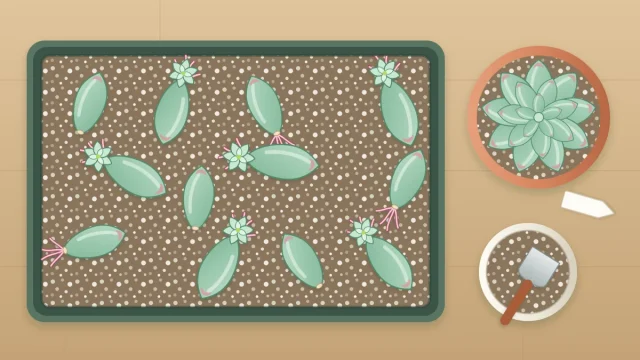
- Rex and other rhizomatous begonias. The leaf is cut into wedges that each contain a main vein, or a whole leaf is pinned flat on the mix with its veins nicked.
- Cape primrose (streptocarpus). The leaf is cut across into sections or lengthwise along the midrib.
Plants it does not work for
This method does not work for most houseplants. A piece of pothos, philodendron or monstera leaf will not root or grow, however carefully it is set, because those plants make new growth only from a node on the stem. Plants that form clumps, such as peace lily and ferns, are divided instead.
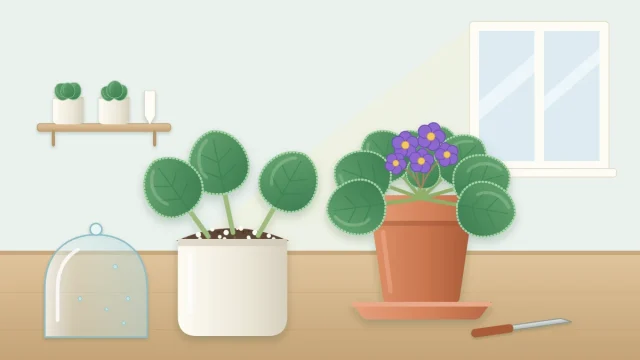
Some other plants grow from a whole leaf with its stalk but not from pieces of blade. African violets and many peperomias belong to that group, which is covered in the guide to leaf petiole cuttings.
Snake plant leaf sections, step by step
Snake plant is the plant most people try first, and the steps are simple as long as you keep track of which way up each piece goes.
- Choose a healthy leaf. Pick a firm, undamaged, full-grown leaf and cut it off near the soil with a clean, sharp knife.
- Cut it into sections. Slice straight across the leaf to make pieces a few inches long. A long leaf gives several.
- Mark the bottom of each piece. Keep track of which end was nearest the soil. A small notch or an angled cut on the bottom end is a common trick, and laying the pieces down in order as you cut helps too.
- Let the cuts dry. Leave the sections somewhere airy and out of direct sun for a day or so, until the cut surfaces look dry.
- Set them in mix. Push the bottom end of each section about an inch (2.5 cm) deep into barely moist, fast-draining mix, and firm it so the piece stands upright.
- Place and wait. Keep the pot in bright indirect light and ordinary room warmth, with the mix barely moist. No humidity cover is needed for this plant.
Why the direction matters
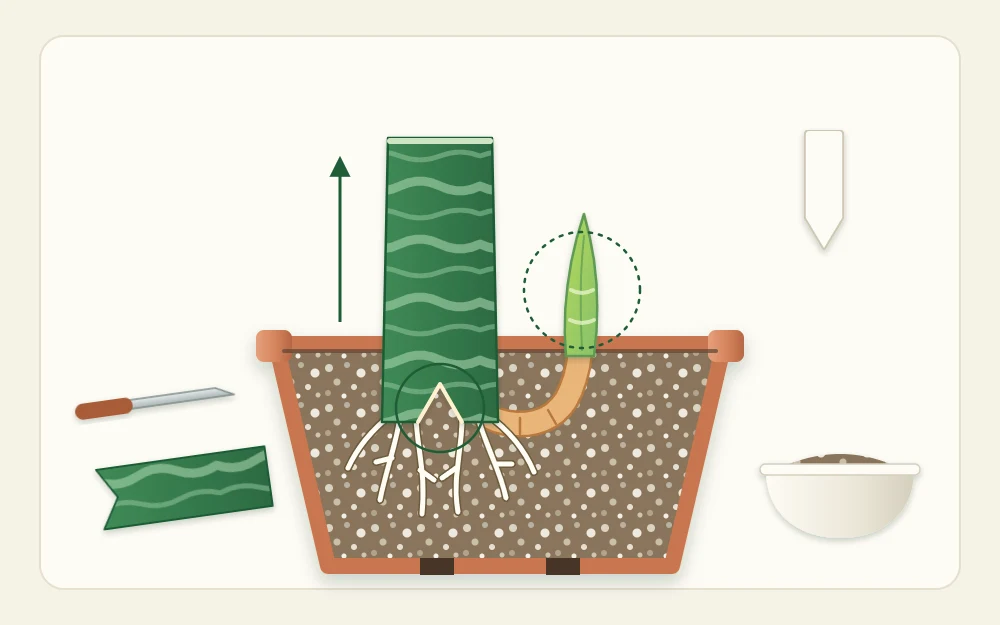
A section of snake plant leaf keeps its sense of up and down after it is cut. Roots form only at the end that was nearest the soil. A section set upside down will not root, which is why you mark each piece as you cut.
The right mix
Snake plant leaves hold a lot of water and decay readily in a wet medium, so the mix needs to drain fast and should be kept only barely moist. The guide to choosing a rooting medium for cuttings covers gritty blends that suit this kind of plant.
What to expect from a snake plant section
Roots grow first from the buried edge. After that, new shoots come from below the soil at the base of the section and emerge beside it as small pointed tips. The original section never grows taller. It acts as a store of food and water for the new plant, and it can be cut away once the new shoot is well established with roots of its own.
This is a slow method with no schedule. Speed depends on the warmth, the light, the season and the leaf itself, and some sections can sit for months, looking unchanged, before a shoot appears. A section that is still firm and green is still alive. One that turns soft and dark at the base is often associated with too much moisture and is best removed.
Good to know
Yellow-edged snake plant varieties generally produce plain green plants from leaf sections. If you want to keep the yellow edge, divide the plant instead.
Division is also the faster route to a full-sized plant. Both methods are compared in the guide on how to propagate a snake plant.
Begonia leaf wedges in brief
Rex and other rhizomatous begonias are handled differently, because their leaves are thin and lose water quickly.
- Choose a healthy, full-grown leaf and remove its stalk.
- Cut the blade into wedges, each one containing a main vein, with the pointed end toward the spot where the stalk was attached.
- Stand each wedge upright with its pointed end set shallowly in moist, airy mix.
- Cover the tray with a humidity cover and keep it in bright indirect light, away from direct sun.

The other approach is to lay a whole leaf flat on the mix, underside down, nick the main veins in a few places and pin the leaf so the cuts stay in contact with the surface. In both versions, plantlets form at the cut veins.
Begonia pieces need high humidity to stay alive until they root, but also some ventilation, since thin leaf tissue in still, wet air is prone to mold. Keep the mix evenly moist, never soggy, and remove any piece that collapses.
Cape primrose leaves
Cape primrose has long, strap-shaped leaves with a thick midrib, and there are two usual ways to cut them. One is to slice the leaf across into sections and stand each in mix with the lower cut edge down. The other is to cut along both sides of the midrib, discard the midrib, and set each long half with its cut edge shallowly in the mix. Plantlets form along the buried edge. Like begonias, these pieces need a humidity cover and evenly moist, airy mix.
Patience, and a few spares
None of these plants is quick from leaf sections, and none of them roots from every piece. Cut more sections than you need, keep them in steady conditions, and judge progress by what you can see: firm, well-colored tissue, then resistance to a light tug, then new growth at the base.
Frequently asked questions
Why did my snake plant leaf cutting not root?
There are several possibilities. The section may have been set upside down, since only the end that was nearest the soil forms roots. The mix may have been too wet, which is often linked with soft, dark bases. It may also simply need longer, because this method is slow.
Will a variegated snake plant stay variegated from a leaf cutting?
Generally not. Yellow-edged snake plant varieties usually produce plain green plants from leaf sections, because the new shoot does not carry the edge pattern. Dividing the plant, so each piece keeps part of the original rhizome and its leaves, is the way to keep the yellow edge.
Can I use leaf sections for pothos or monstera?
No. Pieces of pothos, philodendron or monstera leaf will not grow into plants, because those species produce new growth only from a node on the stem. Use a stem cutting that includes a node. Leaf sections are for snake plant, certain begonias and cape primrose.