Leaf Petiole Cuttings: African Violets, Peperomia and More
How to grow new plants from one whole leaf and its stalk: the short list of houseplants this suits, the steps for an African violet leaf, and what to expect as plantlets form.
At a glance
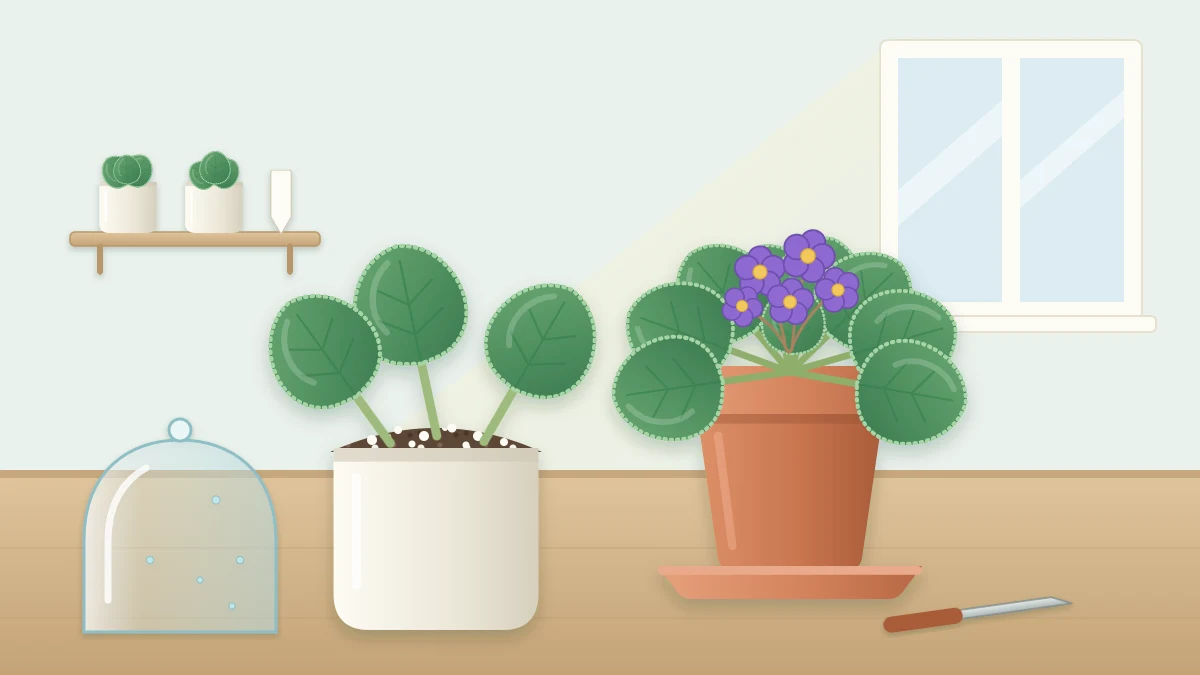
What you need
- Clean sharp blade
- Small pot with drainage holes
- Moist, airy rooting mix
- Pencil for making the hole
- Clear bag or dome as a humidity cover
Rooting speed varies by plant, season and conditions.
A few houseplants can do something most cannot: grow a complete new plant from a single leaf. Leaf petiole cuttings are the simplest version of that. You take one whole leaf together with its stalk, the petiole, set the stalk in rooting mix, and wait for new plantlets to form at its base.
It costs the parent plant almost nothing, and one leaf often gives more than one plantlet. The catch is that the method works only for a limited group of plants, and it asks for patience.
Which plants grow from a leaf and its stalk
Leaf petiole cuttings suit plants whose leaves can form both roots and new buds from the stalk. Among common houseplants, that group includes:
- African violets
- Many peperomias, for example baby rubber plant and the ripple types
- Florist gloxinia
- Some begonias
African violet is the classic example and the model for the steps below. The same approach is used for the others, with the stalk length adjusted to the size of the leaf.
Plants this does not work for
Most houseplants will not regrow from a leaf and its stalk. Pothos, philodendron, monstera and rubber plant are the ones people try most often, and their leaves lack the bud that makes a new stem. On those plants the bud sits at the node on the stem, so a leaf pulled off without a piece of stem leaves it behind.
Such a leaf can stay green for a long time, and may even put out a few roots, which is why the idea persists. It still does not become a plant. Those species need a stem cutting that includes a node. If you are not sure which group your plant belongs to, check the list of propagation methods by plant before you remove a leaf.
Choosing a leaf
On an African violet, pick a firm, mature but not old leaf from the middle rows of the rosette. The small leaves in the center are still growing and are too soft. The large outer leaves are the oldest and tend to be slower and more likely to decay.
Whatever the plant, the leaf should be healthy: good color, no spots, no limp or damaged patches. Take two or three leaves instead of one, since some leaves fail even with careful handling.
How to take and set a leaf petiole cutting
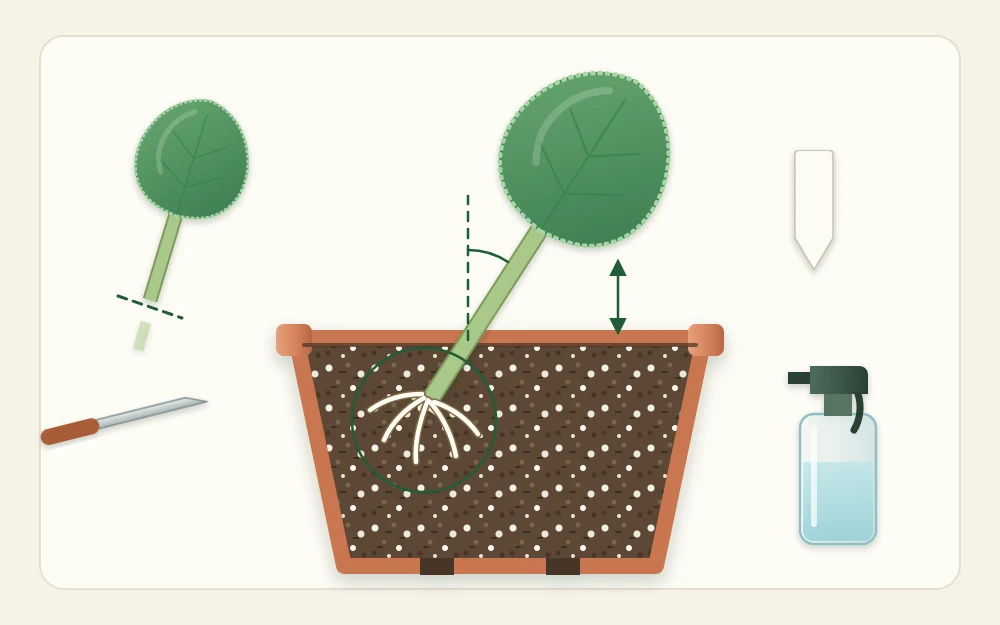
- Remove the leaf. Snap or cut it off cleanly where the stalk meets the parent plant, so no stub is left behind to decay in the rosette.
- Trim the stalk. Cut the petiole to roughly 1 to 1.5 in (2.5 to 4 cm) with a clean, sharp blade. A slanted cut is commonly suggested, with the cut surface facing upward once the leaf is in place.
- Prepare a small pot. Fill it with a moist, airy rooting mix. It should feel like a wrung-out sponge, not wet.
- Insert the stalk at an angle. Make a hole with a pencil and slide the stalk in at a slant, deep enough to hold the leaf steady. The blade should stay clear of the surface, because a leaf blade resting on damp mix tends to decay.
- Firm it in. Press the mix gently around the stalk so the leaf does not rock.
- Cover it. Add a humidity cover, such as a clear bag or dome, with some ventilation so the air inside does not turn stagnant.
Light, moisture and humidity while you wait
Place the pot in bright indirect light. Direct sun through a humidity cover can heat the leaf quickly, so keep it back from a sunny windowsill.
Keep the mix evenly moist, never soggy. A covered pot loses water slowly, so check it by touch instead of watering by habit. Heavy condensation running down the inside of the cover is a cue to open it for a while.
These leaves root best in gentle, steady warmth and humid air. The guide to humidity and warmth for cuttings explains how to provide both without encouraging mold.
Tip
Resist pulling the leaf out to check for roots. If the leaf stays firm and keeps its color, it is doing its job, even when nothing is visible above the surface.
What happens under the surface
Roots come first. They grow from the cut end of the stalk, and for some time that is all that happens. Later, tiny plantlets appear at the base of the stalk and push up through the mix as clusters of very small leaves. There are usually several.
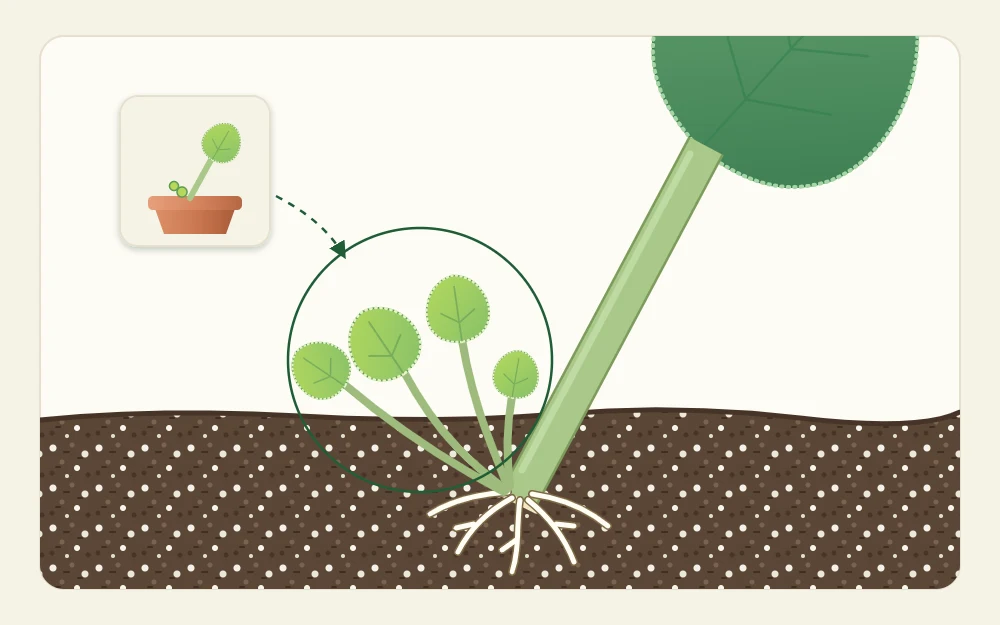
This is slower than rooting a stem cutting, and the timing varies a lot with the plant, the season and the warmth of the room. Roots may form within several weeks in good conditions, while plantlets often take a good deal longer to show, sometimes months. A leaf that is still firm and green is still in progress.
Separating the plantlets
Leave the plantlets attached until they are large enough to handle and have their own roots. Separating them too early is a common way to lose them.
- Tip the whole cluster out of the pot and gently loosen the mix.
- Tease the plantlets apart with your fingers, keeping roots on each one.
- Pot each plantlet in its own small pot of moist, airy mix, with the crown at the surface and not buried.
- Keep the humidity cover on for a short while, then open it a little more each day as they adjust to room air.
The original leaf can be discarded at this stage. For more detail on this plant in particular, see the University of Wisconsin Extension article on African violets.
Honest limits: speed and variegation
Two points are worth knowing before you start.
- It is slow. A stem cutting already has a growing tip. A leaf has to build a whole new plant from a bud that does not exist yet.
- Some plants do not come true. Variegated peperomias, and some patterned African violets known as chimeras, may not come true from a leaf. The plantlets can turn out plain, or with a different pattern from the parent.
If you have a begonia with large patterned leaves, or a snake plant, a related method cuts the leaf blade into pieces instead of using the stalk. It is covered in the guide to leaf section cuttings.
Frequently asked questions
Can I grow a pothos or monstera from a leaf and its stalk?
No. On pothos, philodendron, monstera and rubber plant, the bud that makes a new stem sits at the node on the stem, not in the leaf. A leaf with only its petiole may stay green or even grow roots, but it will not make a new plant. Use a stem cutting with a node.
How long should the stalk be on an African violet leaf cutting?
Trim the petiole to roughly 1 to 1.5 inches, or about 2.5 to 4 centimeters. That is long enough to anchor the leaf at a slant and short enough that the plantlets forming at its base do not have far to travel to reach the surface of the mix.
When should I separate the baby plants from the leaf?
Wait until the plantlets are large enough to handle comfortably and each has roots of its own. Then tip the cluster out, tease the plantlets apart gently and pot each one separately. Separating very small plantlets with few roots is a common reason they fail.