Propagating Succulents From Leaves: Callus, Roots and New Rosettes
Turn fallen or plucked succulent leaves into new plants: which succulents grow from a leaf, how to remove it whole, why it is dried first and when to begin watering.
At a glance
What you need
- Healthy whole succulent leaves
- Plate or paper towel for drying
- Shallow tray with drainage
- Gritty, fast-draining mix
- Small spoon or squeeze bottle for watering
Rooting speed varies by plant, season and conditions.
A plump leaf knocked off an echeveria does not have to go in the trash. Left alone in the right conditions, it can grow roots and a miniature rosette of its own. Propagating succulents from leaves takes very little equipment and almost no effort; what it needs is the right kind of plant, a whole leaf and restraint with water.
That last point surprises people who are used to leafy houseplants. With succulents, the leaf is dried first and kept far drier afterward.
Which succulents grow from a single leaf
Leaf propagation is common practice with succulents whose fleshy leaves detach cleanly from the stem:
- Echeveria
- Graptopetalum, such as ghost plant
- Many sedums
- Jade plant
- Kalanchoe
Succulents that generally do not
Aeonium, most aloes and most haworthias generally do not grow from a single leaf. A leaf taken from one of these typically shrivels without making roots or a new plant. Aeoniums are propagated from stem cuttings, and aloes and haworthias from the offsets that form around the parent plant; see the guide to separating offsets and pups.
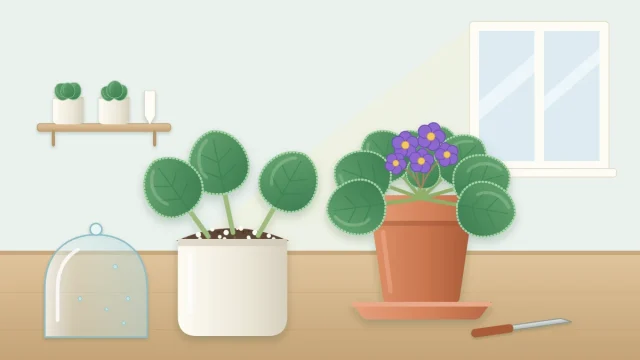
Leafy houseplants handle a leaf differently again. The few that grow from one, such as African violets, need a stalk set in moist mix under a cover, as described in the guide to leaf petiole cuttings.
Removing a leaf so it comes away whole
The new roots and rosette grow from the very base of the leaf, the point where it joined the stem. If that base stays behind on the plant, the leaf has nothing to grow from.
Hold the leaf near the stem and give it a gentle side-to-side twist until it releases. A whole leaf has a clean, slightly curved base. A leaf that snapped partway along, leaving a jagged edge, usually fails and is not worth setting out.

Choose firm, full leaves from the lower or middle part of a healthy plant. Leaves that have fallen off on their own are fine to use if the base is intact and the leaf is still plump.
Step by step: from leaf to tray
- Let the wound dry. Lay the leaves on a dry surface, such as a plate or a paper towel, out of direct sun. Leave them until the wound at the base dries and seals over. This dry seal is the callus.
- Allow enough time. Drying commonly takes a few days, and longer for thick leaves or in humid rooms. Go by the look of the base, which should be dry and closed, not by a count of days.
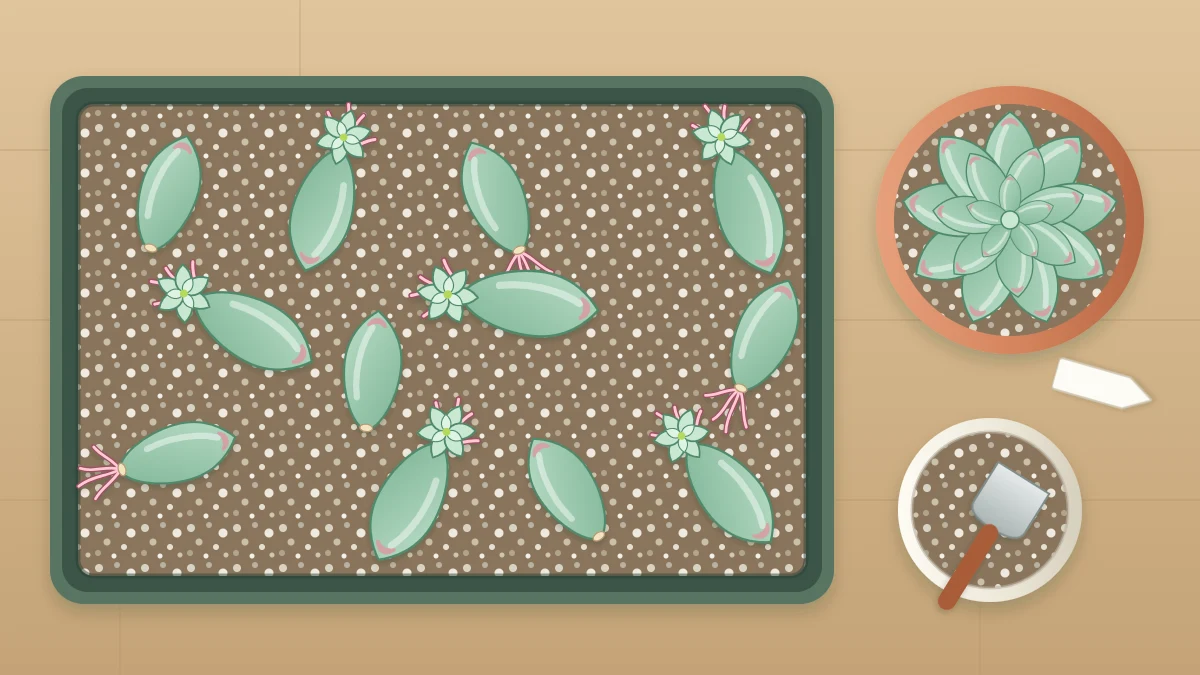
- Prepare a shallow tray. Fill it with gritty, fast-draining mix that is dry or barely moist.
- Lay the leaves on top. Set them on the surface, not buried. A buried leaf base stays damp and tends to decay.
- Give them light. Place the tray in bright indirect light. Strong direct sun can scorch a leaf that has no roots to replace lost water.
- Hold back on water. Leave the tray dry until you see roots.
Tip
Start a dozen leaves instead of two or three. They take up little room on one tray, and a larger batch makes the usual losses much less disappointing.
What you will see: roots, then a rosette
The first sign is usually thin pink or white roots reaching out from the base of the leaf. A tiny rosette follows at the same spot, though on some leaves the rosette shows first. Meanwhile the mother leaf slowly wrinkles and withers as the new plant draws on the water and food stored in it.

How quickly this happens depends on the kind of succulent, the season, the warmth and the light. Some leaves show roots within a few weeks in warm, bright conditions, while others can sit unchanged for months. A leaf that is still plump is still a candidate. For what is going on at the base in the meantime, see how roots develop on cuttings.
Watering once roots appear
Water lightly only once roots appear, and aim at the roots, not at the leaf. A small spoon or a squeeze bottle lets you wet the mix just in front of the roots while the leaf itself stays dry. Then let the mix dry out again before the next light watering.
The target is barely moist around the roots and dry everywhere else. A leaf that turns translucent, mushy or black is commonly associated with too much moisture, although an already damaged leaf can go the same way in a dry tray. Remove it so it does not affect its neighbors, and see the guide to why cuttings rot if several go at once.
Leave the mother leaf alone
It is tempting to pull off the withering mother leaf once the rosette looks like a plant. Leave it attached until it has dried to a crisp husk. Until then it is still feeding the new plant, and tugging it away early can tear the rosette or its roots. Once fully dry, it comes away with a light touch or drops off by itself.
When the rosette has a small root system of its own and the mother leaf is spent, the young plant can be potted up in a small pot of gritty mix and moved gradually into brighter light.
Honest expectations
Leaf propagation is a numbers game, and mixed results are normal.
- Some leaves grow roots and a rosette.
- Some leaves root and never make a rosette.
- Some make a rosette that stalls for lack of roots.
- Some do nothing at all and slowly shrivel.
None of this means you did something wrong. It is the reason to start several leaves at once, and to treat each new rosette as a bonus instead of a certainty.
The opposite of leafy houseplants
If you have rooted pothos in a jar, almost every instinct from that experience points the wrong way here. A soft, leafy cutting goes straight into water or moist mix and is kept humid so it does not wilt. A succulent leaf carries its own water supply, so the order is reversed: dry first, then far less moisture.
Succulent leaves are not kept in water, are not covered with a humidity cover and are not misted to keep them damp.
Frequently asked questions
Why do succulent leaves need to dry before they go on the mix?
A freshly removed leaf has an open wound at its base, and that soft tissue decays easily if it sits on damp mix. Leaving the leaf on a dry surface out of direct sun lets the wound seal into a callus first. Thick leaves and humid rooms generally need longer.
Should I bury succulent leaves or put them in water?
Neither. Lay the dried leaves on top of dry or barely moist gritty mix with the base exposed to the air. Burying the base or standing the leaf in water keeps it wet, which is commonly linked with decay. Succulent leaves carry their own water and need very little moisture.
Can I grow an aloe or haworthia from a leaf?
Generally not. A leaf from most aloes and haworthias typically shrivels without forming a new plant, and the same is true of aeonium. Aloes and haworthias are propagated by separating the offsets that form around the parent, and aeoniums are grown from stem cuttings.