Houseplant Propagation for Beginners: Where to Start
What propagation is, the main methods in plain words, and how to tell which one fits your plant. Includes two gentle first projects and honest expectations about speed and failures.
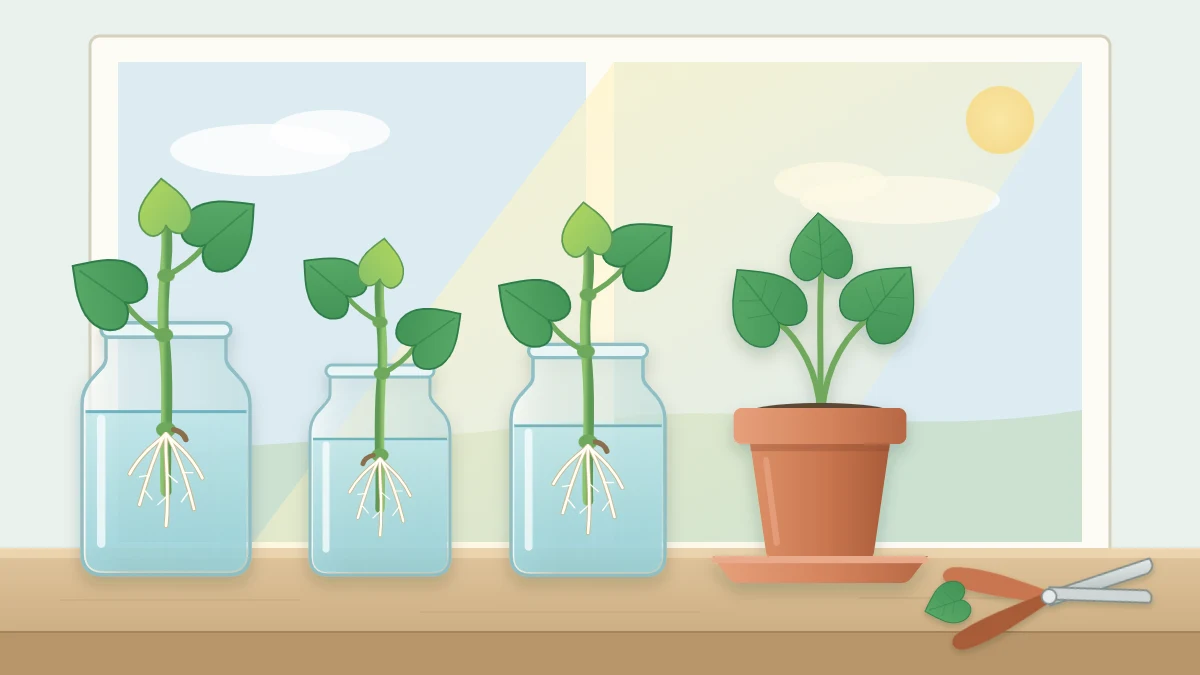
Propagation means growing a new plant from a piece of one you already have. A length of stem, a leaf, a section of a clump or a baby plant is separated from the parent plant and given the conditions it needs to grow roots of its own. Nothing is crossed and nothing is grown from seed, so the new plant is a clone: genetically the same as its parent.
This guide to houseplant propagation for beginners is an orientation, not a set of step-by-step instructions. It covers the main methods, how to tell which one fits the plant in front of you, which projects make a gentle start, and what to expect while you wait.
The method depends on how the plant grows
No single technique suits every houseplant. A vine, a clump and a rosette are built differently, and each can only make a new plant from the parts that carry growing points. That is why the first step is always the same: identify the plant, then look closely at its structure before you pick up anything sharp.
Three questions cover a lot of ground:
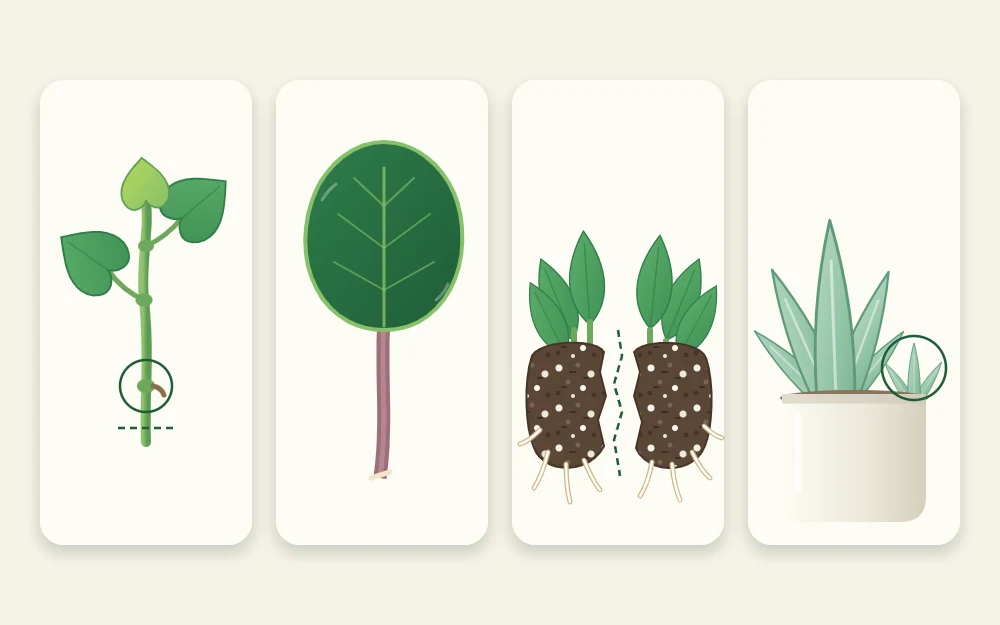
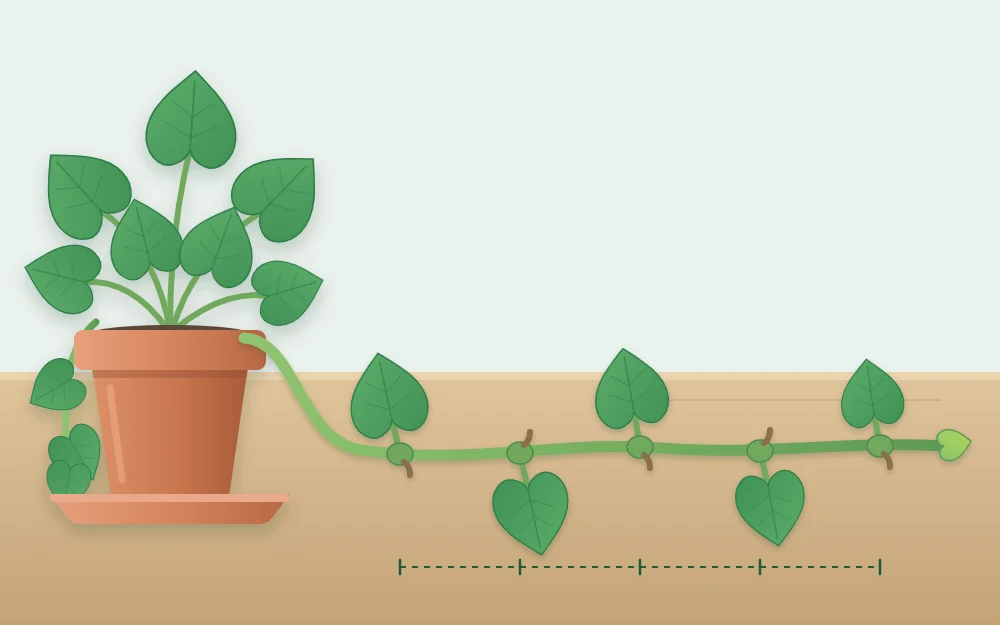
- Does it have stems with nodes? Vining plants such as pothos and heartleaf philodendron have long stems with a leaf at each joint. Those joints are nodes, and a cutting needs one. If the word is new to you, start with what a node is and how to find one.
- Is it a clump of crowns? Peace lilies and Boston ferns grow as several crowns packed into one pot, each with its own leaves and roots. Plants like these are divided, not grown from cuttings.
- Is it a rosette with pups? Aloe and haworthia make small copies of themselves at the base, called offsets or pups, which can be separated once they are large enough to handle.
When you want an answer for one particular plant, the guide to which propagation method suits which houseplant sets common plants side by side, including the methods that do not suit them.
The main methods at a glance
Stem cuttings
A piece of stem with at least one node is cut from the parent and rooted. This is the usual method for vining plants such as pothos, heartleaf philodendron and monstera, and for woody-stemmed plants such as rubber plant and dracaena. A pothos or monstera leaf snipped off without any stem will not grow into a new plant, because the node stayed behind on the vine.
Leaf cuttings
A smaller group of plants can regrow from a leaf alone. African violets are grown from a leaf with its stalk, snake plants from sections of a leaf, and succulents such as echeveria from whole leaves that are left to dry before they touch any mix. In these plants the ability sits in the leaf itself. Plants outside this group do not share it.
Division
A clump is lifted out of its pot and separated into smaller pieces, each with its own crowns and roots. Peace lilies, Boston ferns, snake plants and ZZ plants are propagated this way. Every piece already has roots, so a division is a working plant from the start, although it may pause for a while before it grows again.
Offsets and plantlets
Some plants do most of the work for you. Aloe and haworthia produce offsets at their base, and spider plants carry small plantlets on long runners. These young plants are separated from the parent and potted on their own.
Water and soil are places to root, not methods
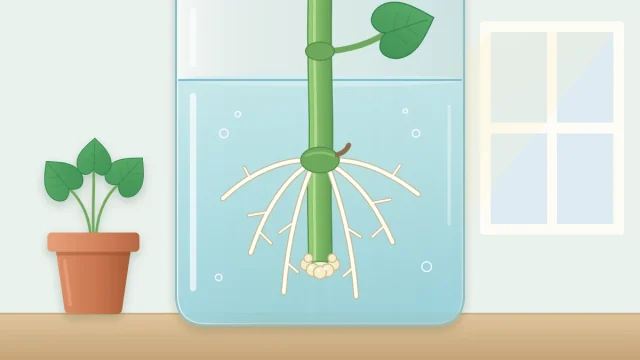
Beginners often ask whether they should propagate “in water” or “in soil”, as if those were two separate techniques. They are really two places to root the same cutting. A pothos stem cutting is a stem cutting whether it sits in a glass jar or in a small pot of rooting mix.
Water lets you watch what is happening, which is reassuring the first time, and it suits vines such as pothos and heartleaf philodendron. A rooting mix suits those vines too, and it is the right place for succulents such as jade plant and echeveria, which are dried first and rooted in a gritty mix instead of being kept in water.
Good first projects
Two projects are kind to a first attempt, for different reasons.
- Pothos or heartleaf philodendron stem cuttings. The nodes are easy to see, the stems are soft enough to cut cleanly, and a mature vine usually has length to spare, so you can take several cuttings at once. The steps are in how to take stem cuttings.
- Spider plant plantlets. Each plantlet is already a miniature plant, often with the beginnings of roots at its base. There is no node to find and no decision about where to cut the stem.
Both leave the parent plant looking much as it did before, which takes some of the pressure off.
Choose a healthy parent and a good moment
A cutting begins with only what the parent gave it, so choose a parent in good condition: firm, well-colored leaves, steady new growth, no pests under the leaves or in the joints, and no soft or dark patches on the stems. A struggling plant tends to give weak cuttings, and removing pieces from it adds to its stress.
Timing helps as well. Houseplants generally grow most actively in spring and summer, when days are longer and rooms are warmer. A plant that is already pushing out new leaves has energy to spare for making roots. In the darker months the same cutting may simply sit, so expect slower progress if you try then.
What to expect while you wait
How quickly anything happens varies widely. Species, season, temperature, light and the health of the parent all change the pace, so a calendar is a poor guide. Watch the cutting instead: pale bumps at a node, white roots that begin to branch, and eventually a new leaf.
Some cuttings fail even when everything is done well. A stem turns soft, a leaf yellows and drops, or nothing happens at all. That is an ordinary part of propagation, not proof that you did something wrong. The practical answer is to take more than one cutting whenever the parent can spare it, so a single loss does not end the project.
Tip
Write the plant name and the date on a label for every jar or pot. It is the simplest way to learn how your own plants behave in your own rooms.
What you need before the first cut
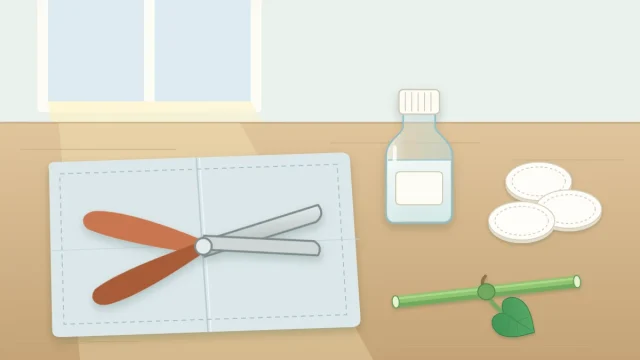
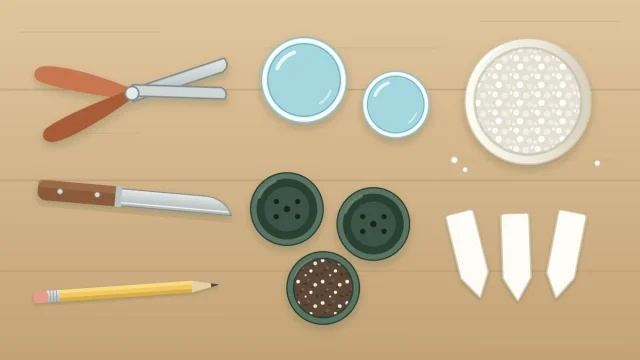
Very little: a clean, sharp pair of scissors or snips, a jar or a small pot with drainage holes, and something for the cutting to root in. The full list, sorted into what is essential and what can wait, is in propagation tools and supplies.
Then pick one plant, look at how it grows, and follow the guide for the method that matches it.
Frequently asked questions
What is the easiest houseplant to propagate for a first try?
Pothos and heartleaf philodendron are common first choices because their nodes are easy to see and their soft stems cut cleanly. Spider plant plantlets are another gentle start, since each one is already a small plant. Even with these, some pieces fail, so take a few.
Can I use the same method on every plant I own?
No. The method follows the way the plant grows. Vines with nodes are grown from stem cuttings, clumping plants such as peace lilies and Boston ferns are divided, and plants such as aloe are grown from offsets. Identify the plant and look at its structure before choosing.
Is a propagated plant identical to its parent?
A plant grown from a cutting, a division or an offset is a clone, so it carries the same genes as the parent. It can still look a little different while young, and some variegated plants do not always keep their pattern, depending on the plant and the method used.