Types of Stem Cuttings: Tip, Section and Single-Node Cuttings
Tip cuttings, cane sections and single-node cuttings explained: what each one includes, which houseplants it suits and how to set it the right way up.
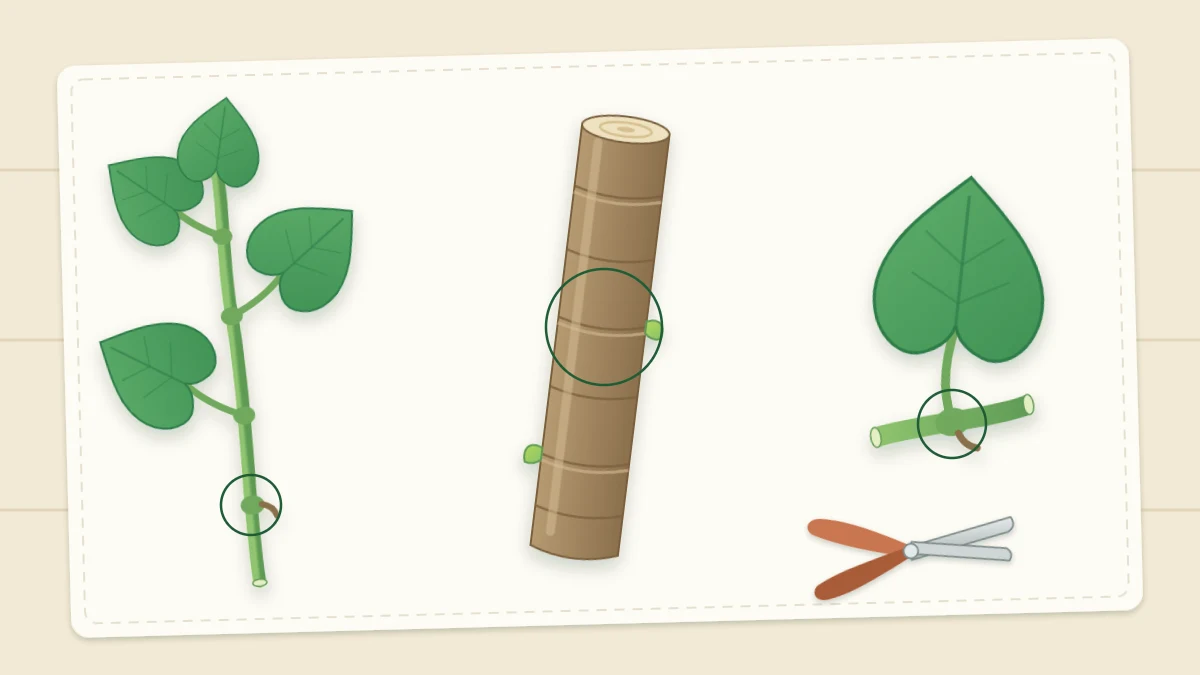
Propagation guides use several names for what sounds like the same thing: tip cutting, cane cutting, stem section, leaf-bud cutting, single-node cutting. They are all pieces of stem, but they are cut differently and they suit different plants.
The types of stem cuttings that houseplant growers use come down to three forms. Knowing which is which helps you read instructions correctly and choose the form that matches the way your plant grows.
The three forms at a glance
| Type | What it includes | Suits | Things to know |
|---|---|---|---|
| Tip cutting | The growing end of a stem with several leaves | Pothos, philodendron, coleus, tradescantia, peperomia, hoya | The usual choice; keeps growing from its existing tip |
| Stem section (cane cutting) | A leafless or nearly leafless piece of thick stem with at least one node | Dracaena, dieffenbachia | Must be set the same way up as it grew, or laid on its side |
| Single-node cutting | One leaf, a short piece of stem and its node | Pothos, philodendron, hoya, monstera | Many plants from one vine; slower to fill out |
What all three share is the node, the joint where a leaf meets the stem. If the term is new to you, start with what a plant node is, because every cutting described here depends on it.
Tip cuttings
A tip cutting is the growing end of a stem, taken with several leaves attached. It is the form most people picture when they hear the word cutting, and it is the usual choice for branching and vining plants such as pothos, philodendron, coleus, tradescantia, peperomia and hoya.
Its advantage is that it already has a working growing point. Once the piece has roots, the tip can carry on lengthening and adding leaves, so the new plant looks like a plant fairly early.
The limit is supply. Each stem has only one tip, so a plant with three stems gives you three tip cuttings unless you go on to use the rest of the stem in another way.
Stem section or cane cuttings
Stem sections are leafless or nearly leafless pieces of thick stem. They are used for cane-forming plants such as dracaena and dieffenbachia, which tend to end up as a tuft of leaves on top of a long bare stem. After the leafy top is removed, the bare cane below can be cut into pieces, each with at least one node.
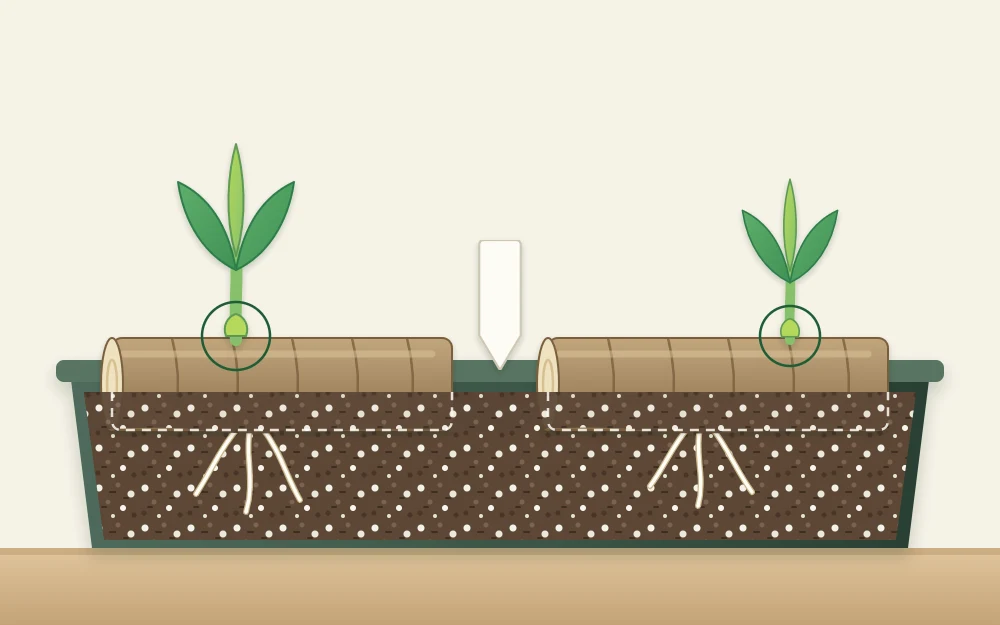
The nodes on a bare cane show as rings or slight ridges where leaves used to be attached. Each one holds a dormant bud, and new shoots come from these buds, not from the cut ends.
There are two ways to set a section in rooting mix:
- Upright, with the lower end pushed into the mix, the same way up as it grew.
- On its side, laid horizontally and half-buried, so that a node sits at or just above the surface.
The orientation rule
A stem section has a top and a bottom even when it has no leaves to show you which is which. The end that was nearer the roots goes down. A piece set upside down generally fails, because the stem keeps its original direction of growth.
Bare sections all look alike once they are on the table, so mark them as you cut. A simple habit is to make the bottom cut straight and the top cut slanted on every piece. Laying sections on their sides avoids the question altogether.
Good to know
Dieffenbachia sap can irritate the skin and mouth. Wear gloves when you cut the canes, keep your hands away from your face, and wash your tools and hands when you finish.
Single-node cuttings
A single-node cutting, also called a leaf-bud cutting, is the smallest piece that still counts as a stem cutting: one leaf, a short piece of stem, and the node that joins them. You make them by cutting a long vine into pieces between the leaves, so every leaf leaves with its own node.
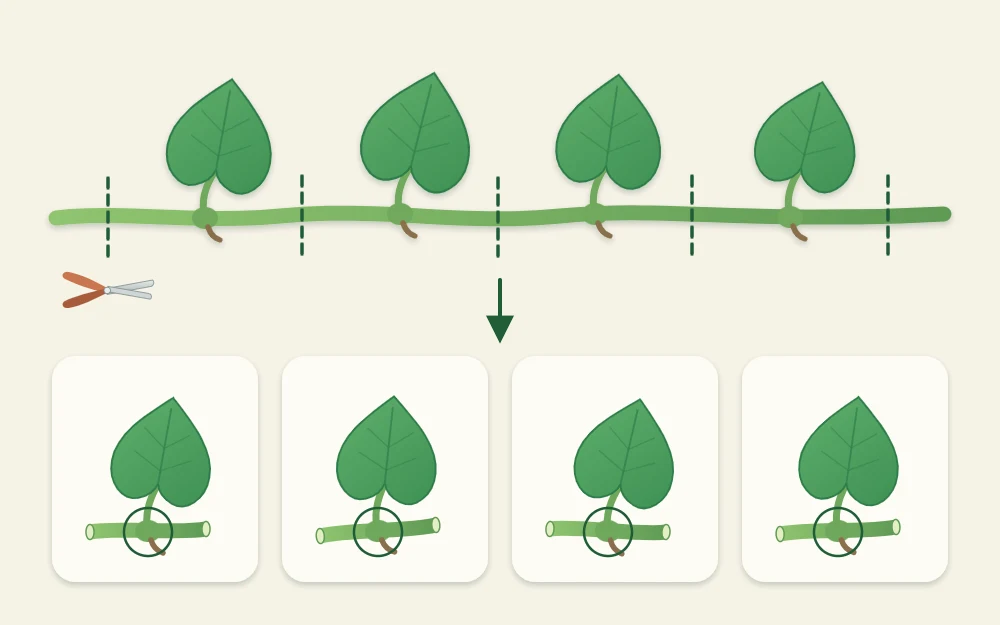
This is a way to make many plants from one stem, and it is commonly used for pothos, philodendron, hoya and monstera. A vine that would give one tip cutting might give six or eight single-node pieces.
The trade-off is pace. Each piece starts from a single bud at its node, with one leaf to feed it, so it is slower to fill out than a tip cutting that already has a growing point and several leaves. Expect one new shoot per piece, and expect some pieces to fail; that is normal when you divide a stem this finely.
Monstera is the large-scale version, where each piece is a thick length of stem with one leaf and often an aerial root. The guide on how to propagate monstera covers where to cut on that plant.
Why a piece without a node is not a cutting
Every form above includes at least one node, and that is not a detail. Roots on these plants start at or near the node, and the bud that becomes a new stem sits there too. A length of internode, or a leaf with only its petiole, has neither.
A pothos, philodendron or monstera leaf snipped off without its node can stay green in a jar for a long time and may even grow a few roots from the stalk, but it will not produce a new stem. It is not a tip cutting, a section or a single-node cutting; it is just a leaf. When a cutting of these plants never grows, a missing node is one of the first things to check.
Choosing a type for your plant
Let the plant’s shape decide.
- A trailing or bushy plant with plenty of stems: take tip cuttings. They are the simplest form and the quickest to look like a plant.
- One long vine and a wish for many plants: use the tip as a tip cutting and divide the rest into single-node cuttings.
- A leggy dracaena or dieffenbachia: root the leafy top as a tip cutting and cut the bare cane into stem sections.
For thick or woody stems that are slow from cuttings, there is another option that avoids cutting first. With air layering, roots form on the stem while it is still attached to the parent plant, and the cut comes afterward.
None of the three forms is certain to root, so take more pieces than you need.
Frequently asked questions
What is the difference between a tip cutting and a single-node cutting?
A tip cutting is the growing end of a stem with several leaves and an active growing point. A single-node cutting is one leaf with a short piece of stem and its node. The single-node form gives more plants from one vine, but each starts from one bud and is slower to fill out.
Which way up does a cane cutting go?
The end that was nearer the roots goes down into the mix. Because bare sections look the same at both ends, mark them as you cut, for example with a straight cut at the bottom and a slanted cut at the top. You can also lay sections on their sides, half-buried.
Is a leaf with its stalk a type of stem cutting?
Not for vining plants such as pothos, philodendron and monstera. A leaf with only its petiole has no node, so it has no bud to grow a new stem from. It may stay green for a long time, but it will not become a plant. Include a piece of stem with the node.