Houseplants That Root in Water (and Some That Rarely Do)
A plant-by-plant look at water rooting: the houseplants widely rooted in a jar, the ones that are slower or less reliable, and the poor candidates that need division, gritty mix or air layering.
Before you put a cutting in a jar, it helps to know whether that particular plant is a good candidate. Some houseplants that root in water do so readily, some manage it slowly and unevenly, and some are far more likely to rot than to root. The difference comes down to how each plant is built.
This is the plant-by-plant companion to the step-by-step guide on how to propagate plants in water. The method lives there. Here you will find three groups: plants widely rooted in water, plants that are possible but less reliable, and poor candidates that need a different approach.
Group one: plants widely rooted in water
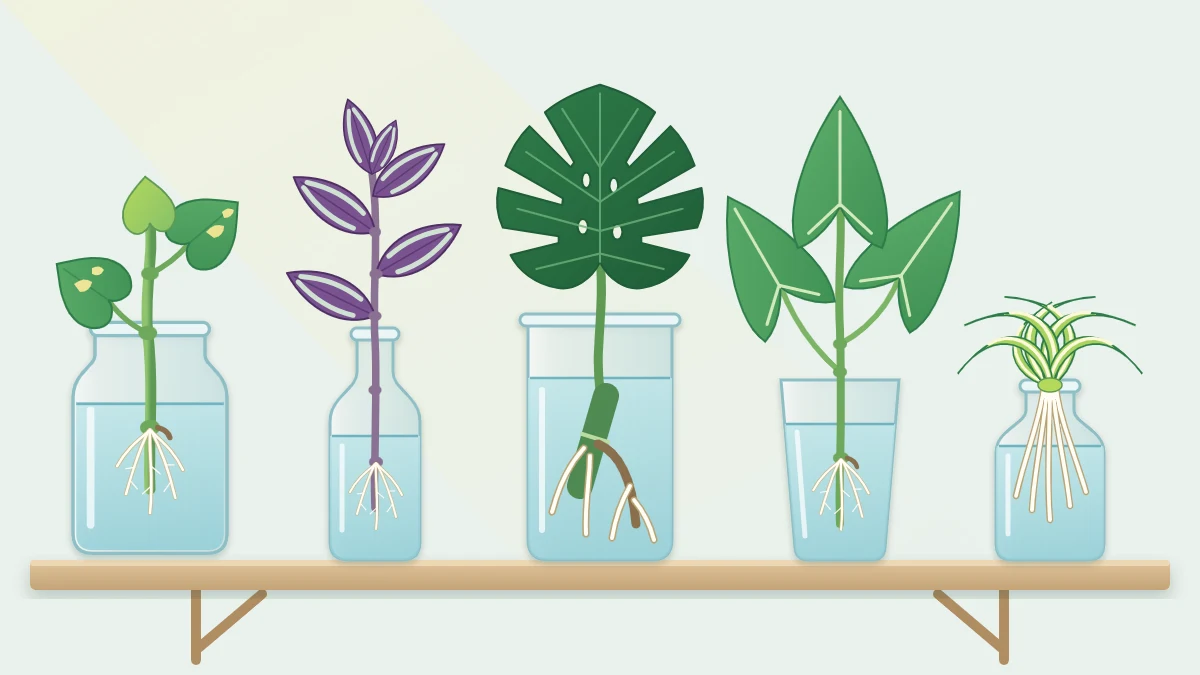
These plants are commonly rooted in water from a stem cutting that includes a node, or from a baby plant that already has root nubs. A leaf on its own is not enough for the vining plants in this list: a pothos or monstera leaf without a node will not grow into a new plant.
| Plant | Part to put in water | Things to know |
|---|---|---|
| Pothos | Stem cutting with a node | A common first plant for water rooting |
| Heartleaf philodendron | Stem cutting with a node | Handled the same way as pothos |
| Tradescantia | Tip cutting with a node | Stems are brittle, so handle gently |
| Monstera | Stem section with a node | Needs a larger, stable jar |
| Coleus | Tip cutting with a node | Soft stems that wilt if left out of water |
| Syngonium (arrowhead vine) | Stem cutting with a node | Nodes often carry root nubs already |
| Hoya | Stem cutting with a node | Often slower than the others |
| Cane begonia | Stem cutting with a node | Keep the leaves dry and above water |
| Pilea | Pup, base only in water | Useful for pups that came away rootless |
| Spider plant | Plantlet, base only in water | Choose plantlets with root nubs |
| Lucky bamboo | Stem cutting with a node | Often grown in water long-term |
Pothos is the usual starting point, and the pothos propagation guide walks through where to cut and how many nodes to include.
Even good candidates vary
Being in group one is not a promise for every cutting. Results vary with the season, the health of the parent plant and the light the jar receives. A cutting taken from a strong plant in active growth and kept somewhere warm and bright has much better prospects than one taken from a struggling plant in midwinter.
For the same reason there is no dependable timetable. Some vines show roots within a couple of weeks in warm bright conditions, while others can take months, and hoya is often on the slow side. Watch for pale bumps at the node and then white roots that begin to branch.
Some cuttings fail anyway. Taking several at once is the sensible way to allow for that.
Group two: possible, but slower or less reliable
These plants can form roots in water, but they are slower, and a larger share of cuttings stall or rot along the way. Rooting hormone is optional for them; it may help with slow plants, and you should read and follow the product label if you use it.
- Rubber plant and fiddle-leaf fig: stem cuttings with a node sometimes root in water, but these are woodier plants and they are slow. Let the milky sap stop flowing before the cutting goes in the jar. The sap can irritate skin, so wash it off your hands.
- ZZ plant: a whole stem cut near the base can stand in water. It is known for being slow, so patience is part of the method.
- Snake plant: leaf sections can root in water if they are kept the same way up as they grew. They are prone to going soft at the cut end, so keep the water shallow and fresh.
- Peperomia: some types root in water from a stem cutting, but the fleshy stems rot more easily than those of a pothos. Many growers find a rooting mix more dependable for them.
With any plant in this group, treat water as one option among several. If cuttings keep failing in a jar, a rooting mix or a different method is worth trying before you give up on the plant.
Group three: poor candidates for water
For these plants a jar of water is the wrong tool, and each has a method that suits it better.
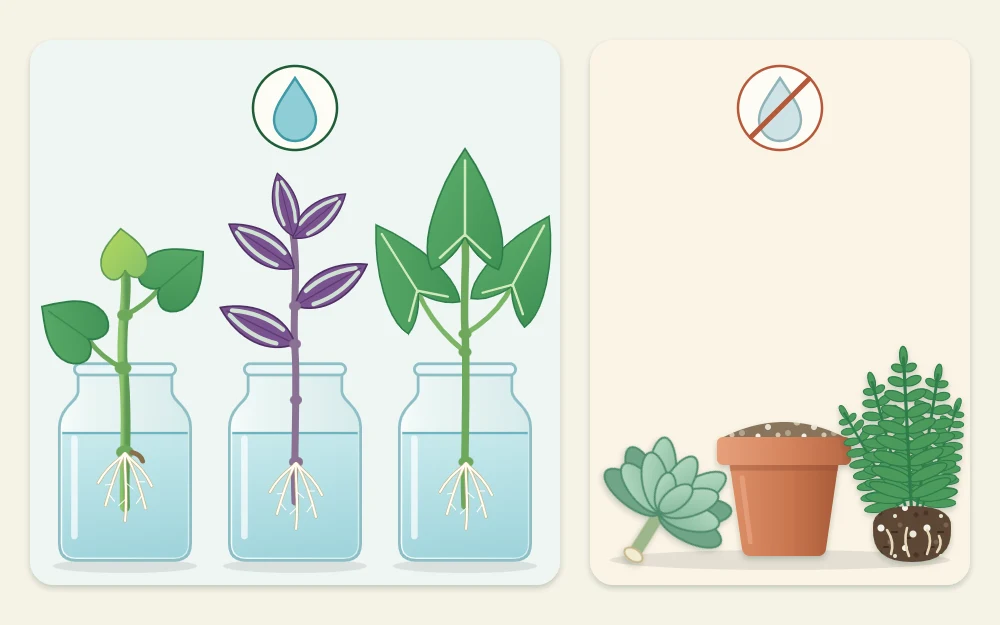
Most succulents and cacti
Succulents and cacti store water in their tissue, and their cut ends tend to rot when kept wet. They are handled the opposite way: the cut end is left to dry until it forms a callus, and the cutting is then rooted in a gritty, barely moist mix.
Plants with no stem to cut
Peace lily, ferns and calathea grow as clumps of leaves rising straight from the soil. There is no stem with nodes to take a cutting from, and a single leaf stood in water will not produce a new plant. These plants are divided instead, by splitting the clump into sections that each have roots and a growing point.
Woody plants
Plants with firm, woody stems usually do not root well from a cutting in water. They are more often propagated by air layering, where roots are encouraged to form on the stem while it is still attached to the parent plant.
If your plant is not listed
No list covers everything. If your plant is missing, look at how it grows and compare it with the groups above. A soft trailing stem with obvious joints puts it closer to group one. A woody trunk, fleshy water-storing leaves or a clump with no visible stem points toward the other groups.
The chart of propagation methods by plant matches common houseplants with the methods that suit them, which is the quickest way to find an alternative when water is not a good fit. For a broader overview of methods, see Iowa State University Extension on propagating houseplants.
Tip
When you are unsure about a plant and it can spare the material, split your cuttings between a jar of water and a small pot of rooting mix. You will see which one that plant prefers without staking everything on one method.
What good candidates have in common
Look back over group one and a pattern shows. The plants that do well in water share two features:
- Soft, flexible stems. Green, bendable growth forms roots more readily than hard, woody growth, and it tolerates sitting in water.
- Visible nodes or root nubs. Clear joints along the stem, often with a small aerial root or bump already present, show you exactly where roots will come from. Pups and plantlets with nubs at the base are the same idea in a different shape.
A plant with both features is worth trying in a jar. A plant with neither is better served by division, a gritty mix or air layering, depending on how it grows.
Frequently asked questions
Which houseplant is the simplest to root in water?
Pothos and heartleaf philodendron are common first choices because their soft stems have obvious nodes, often with a small root nub already present. Tradescantia and spider plant plantlets are also widely rooted in water. Even with these, some cuttings fail, so take a few.
Can succulents be rooted in water?
Most succulents and cacti are poor candidates. Their cut ends tend to rot when kept wet, because the tissue already holds a lot of water. The usual approach is to let the cut end dry until it forms a callus and then root the cutting in a gritty, barely moist mix.
Why will my peace lily leaf not root in water?
A peace lily grows as a clump of leaves from the soil and has no stem with nodes to take a cutting from, so a single leaf in water will not become a new plant. Peace lilies, ferns and calatheas are propagated by division, splitting the clump into rooted sections.